
The right paperwork for your pet depends less on having a single “pet passport” and more on where the journey begins and ends. That’s the key to understanding pet travel documents Philippines requirements. Travel into the country, travel out of it, and domestic journeys can each involve different permits and health-document categories.
It’s easy to feel unsure when advice about health certificates, vaccination records, and permits seems to conflict. The paperwork isn’t one-size-fits-all: a document that matters for one route may not apply to another. Start with your pet’s exact itinerary to make the process more manageable.
This guide explains which document categories may apply to inbound, outbound, and domestic journeys, and how to organize them before travel. You’ll also learn why timing and consistent details across records matter, and how permit-processing and travel-document assistance can help. Requirements can change, so use this checklist to plan and confirm current rules with the relevant authorities before your pet travels. You can also check your pet’s route on the FurExpress route dashboard.
Key Takeaways
- Use your pet’s route to identify which permit and health-record categories may apply.
- Understand what common travel documents record and which authority or professional determines their requirements.
- Build a route-specific checklist for pet travel documents Philippines, then confirm current rules before applying.
- Compare names, pet details, dates, and identification numbers across records to catch inconsistencies early.
- FurExpress assists with Philippine permit processing, travel-document coordination, and rabies titer testing logistics.
Pet travel documents in the Philippines: why the route matters
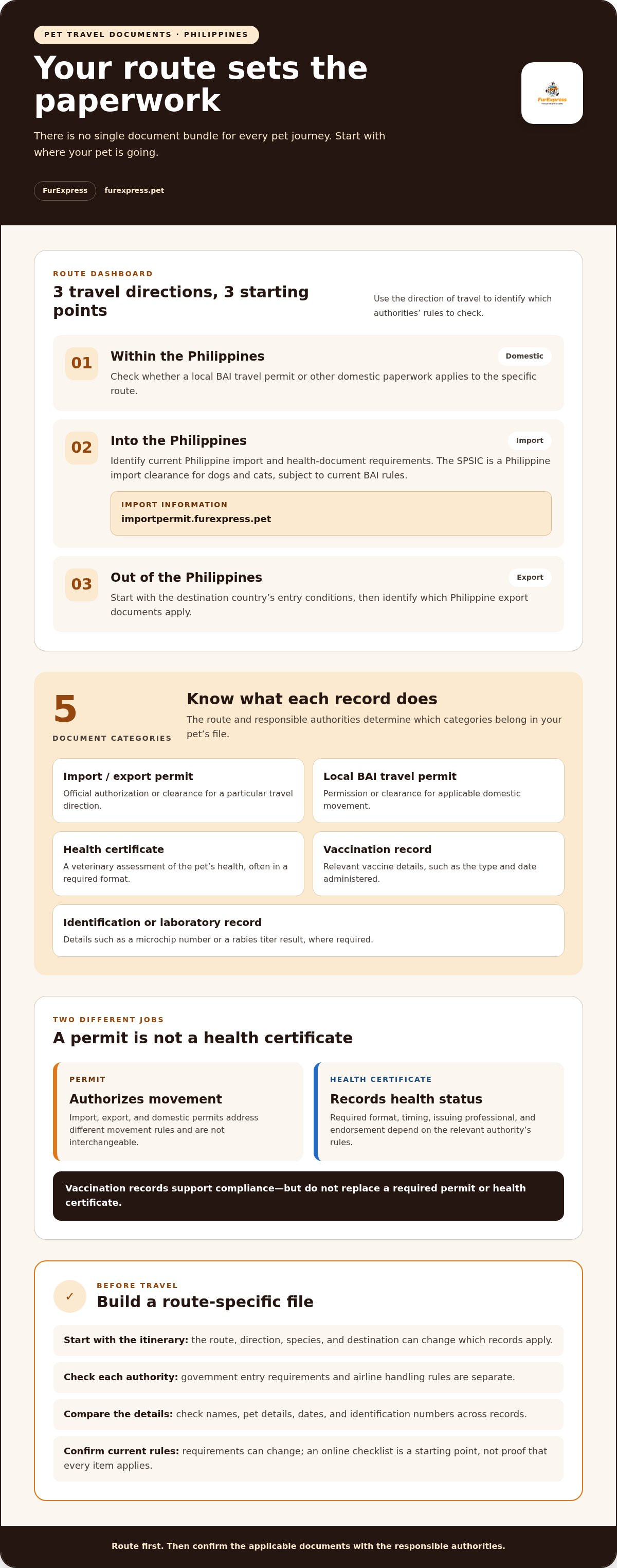
There is no single document bundle for every pet journey. A dog travelling between places in the Philippines may need different paperwork from a cat entering the country or a pet leaving for an overseas destination. Start with the route, then build your checklist around the rules for that journey.
Pet travel documents are the official permits and health or identification records required for a specific route. A checklist helps you gather the relevant records, but it isn’t an official pet passport or travel credential. The phrase Pet passport can describe documents used to show a pet’s identity and health history for travel, but terminology and requirements vary by jurisdiction. For pet travel documents Philippines, the route and applicable authorities determine what is required.
What does pet travel paperwork include?
Paperwork can include several distinct categories. A permit is an official authorization or clearance for a journey. A health certificate records an assessment of the animal’s health, while vaccination records show relevant vaccination history. Identification records, such as microchip details where required, help connect the documents to the correct pet.
These categories don’t automatically apply to every trip. A document may be required for one direction, species, or destination but not another. Government authorities set official requirements, and destination rules can add conditions. Treat an online checklist as a starting point, not proof that every item applies to your pet’s route.
Why domestic and international journeys need different checklists
For domestic travel, first determine whether a local Bureau of Animal Industry (BAI) travel permit or other local documentation applies to the route. Domestic journeys don’t cross an international border, so overseas import rules aren’t the basis of the checklist. The applicable local requirements still need to be checked for the specific trip.
International travel involves another set of rules. If your pet is entering the Philippines, Philippine import requirements apply. If your pet is leaving, the destination country sets its entry conditions, which may include permits, health documents, vaccination evidence, or identification records. The country of origin and the way your pet travels can also affect the paperwork. Airline handling rules are separate from government entry requirements, so a document that satisfies one doesn’t necessarily satisfy the other.
- Within the Philippines: Check whether a local BAI travel permit or other domestic paperwork applies.
- Into the Philippines: Identify the current Philippine import and health-document requirements for your pet’s route.
- Out of the Philippines: Start with the destination country’s rules, then identify the Philippine export documents that apply.
The sections below explain these routes in more detail. Use the one that matches your pet’s direction of travel, then confirm current requirements with the responsible authorities before preparing the final set of records.
The main pet travel document types and what each one proves
Travel paperwork is easier to organize when each document has a clear purpose. Some records authorize movement; others show health, vaccination, or identity details. For pet travel documents Philippines requirements, the route and responsible authorities determine which types belong in your pet’s file.
A permit authorizes movement, while a health certificate records an animal’s health status. They serve different purposes, so one generally cannot replace the other.
| Document type | What it records or authorizes | Who determines the requirement |
|---|---|---|
| Import or export permit | Official authorization or clearance for a particular travel direction | Relevant government authorities, including the origin and destination countries |
| Local BAI travel permit | Permission or clearance for applicable domestic movement | The Bureau of Animal Industry (BAI) and relevant local rules |
| Health certificate | A veterinary assessment of the pet’s health, often in a required format | Destination authorities and any government endorsement rules |
| Vaccination record | Vaccine details, such as the type and date administered | Authorities responsible for the route’s health conditions |
| Identification or laboratory record | Details such as a microchip number or a rabies titer result | Destination authorities, where these records are required |
Permits, including SPSIC and BAI travel permits
The Sanitary and Phytosanitary Import Clearance (SPSIC) is a Philippine import clearance for dogs and cats, subject to current BAI rules. A local BAI travel permit may apply to certain domestic movements. These permits are not interchangeable: an import permit addresses entry into a country, while an export permit concerns departure under the applicable rules. Check the route and current official guidance to determine which applies.
Health, vaccination, identification, and laboratory records
A health certificate is route-dependent evidence of a pet’s health at the time of assessment. The required form, timing, issuing professional, and any government endorsement depend on the relevant authority’s rules. Don’t assume a certificate used for one destination will meet another destination’s requirements.
Vaccination records support compliance, but they don’t replace an import or export permit or a required health certificate. Keep the rabies entry legible and consistent with the pet’s other paperwork. Check that names, dates, and identifying details match across records. If a destination requires a microchip, rabies titer result, or parasite-treatment record, make sure the relevant details and dates are clear.
Keeping these categories separate makes it easier to see what is missing. For help with Philippine import or export permits, local BAI permits, and related travel-document logistics, FurExpress can assist with pet travel paperwork. For import details, see the FurExpress import permit information.
Which pet travel documents apply to each Philippine travel route?
The quickest way to narrow down pet travel documents Philippines requirements is to sort the journey by direction. Domestic movement, departure from the Philippines, and arrival in the Philippines involve different rules and authorities. Use the comparison below as a starting point, then confirm current requirements for your pet’s species, route, and travel arrangement.
| Route | Document categories to investigate | Responsible authorities | Route-specific facts to verify |
|---|---|---|---|
| Within the Philippines | Applicable local BAI travel permit; supporting health, vaccination, or identification records if required | Philippine Bureau of Animal Industry (BAI) and relevant local authorities | Whether a permit applies to the particular movement, and which supporting records current instructions require |
| Leaving the Philippines | Philippine export documentation; destination-entry permit, health certificate, vaccination, or identification records as applicable | BAI and the destination country’s animal health or border authorities | Destination conditions, required certificate format or endorsement, timing, and any transit-country rules |
| Entering the Philippines | Philippine import clearance, including the SPSIC where applicable; health and supporting records required for entry | BAI and relevant Philippine authorities | Current import conditions for the pet’s species and origin, including health, vaccination, and identification requirements |
Domestic travel within the Philippines
For a journey within the country, include an applicable local BAI travel permit in your document check. Don’t assume every domestic trip requires the same supporting records. Check current BAI instructions for the route, then gather health, vaccination, or identification documents where required. The method of travel may also affect carrier paperwork, which is separate from government requirements.
International travel from or into the Philippines
For an outbound journey, separate Philippine export documentation from the destination country’s entry rules. The destination authorities determine many of the documents needed for admission. An export permit doesn’t replace destination clearance, and an import permit for the Philippines doesn’t apply simply because a pet is leaving.
For an inbound journey, check the SPSIC and the health records required under current Philippine rules. The exact documents may depend on the pet’s species and origin. If the trip includes a transit stop or layover, check whether the authorities add conditions. Airline rules may also apply, but they don’t replace government requirements. For import information, visit importpermit.furexpress.pet.
Keep each route’s paperwork in its own checklist. Confirm document names, issuing authorities, required formats, and validity dates against current official instructions. Separating the files helps prevent a permit or certificate intended for one direction from being mistaken for a requirement on another.
How to assemble a pet travel document checklist before booking
A checklist turns scattered records into a manageable plan. For pet travel documents Philippines requirements, work from your pet’s exact itinerary and current official instructions rather than relying on a generic list. Track what is required, what is ready, and what still needs attention.
- Define the route. Note the travel direction, destination, any transit or layover points, your pet’s species, and the planned travel date. These details help distinguish domestic requirements from import or export rules and identify which authorities’ instructions apply.
- Check official rules. Review current BAI guidance for Philippine permits and entry or exit requirements. For an international journey, consult the destination authority’s official rules too. Record whether the route calls for a government permit, veterinary health record, laboratory record, or particular endorsement.
- Gather relevant records. Collect the documents that apply to this journey, such as permit details, health certificates, vaccination records, identification information, and any required laboratory results. Don’t add documents just because they appear on a checklist for a different country or route.
- Apply for permits and arrange supporting records. Follow the application instructions and timing set by the responsible authority. Some records may need to be issued or endorsed within a specified period, so use official validity rules to plan the sequence rather than assuming every document can be prepared at once.
- Review the complete set. Compare each document before travel. Check that your pet’s name or description, species, identification number, dates, and other details agree across permits, certificates, and vaccination records. Confirm that documents remain valid for the travel date and meet the required format.
Keep the route and records easy to track
Use a tracker to note each document’s name, the authority or professional responsible for issuing it, its status, any validity information, and the next action. This makes it easier to spot a missing step without treating every category as mandatory. For international journeys, review health-document instructions for the specific destination and route, including endorsement rules.
Keep readable digital copies as a backup. Carry the required originals or endorsed copies in the form instructed by the relevant authorities and airline. A phone image can help you refer to a record, but it doesn’t replace an original when one is required.
Final cross-check: match every document to your pet, confirm that details and dates agree, and carry the originals or endorsed copies required for the route. For help with permit coordination, get assistance coordinating your pet’s travel documents.
How FurExpress helps coordinate Philippine pet travel documents
Once you know the route and document categories that may apply, the next task is coordinating them with the travel plan. FurExpress assists with Philippine import and export permit processing and local Bureau of Animal Industry (BAI) travel permits where relevant. This helps organize related paperwork, while the responsible authorities determine requirements and make permit decisions.
A pet’s records and travel arrangements are connected. The route, destination, and method of air travel all shape the planning process. FurExpress supports pet travel documents Philippines needs as part of a wider travel-coordination service, with paperwork organized around the specific journey.
Permit and health-document coordination
For a pet entering the Philippines, FurExpress assists with Philippine import permit processing. For a pet leaving the country, FurExpress assists with Philippine export permit processing. These are different travel directions, and neither replaces requirements set by the destination country or another authority involved in the route. FurExpress also processes local BAI travel permits for domestic journeys where a permit applies.
Rabies titer testing can involve logistics and careful record handling. FurExpress assists with rabies titer testing logistics and related documentation, keeping the paperwork connected to the pet’s travel file. This is documentation and coordination support, not veterinary treatment. Any examination, vaccination, sample collection, or other medical care remains with the appropriate veterinary professional.
Permit processing and supporting records follow the current instructions of the relevant authorities. FurExpress coordinates applicable assistance, while the authorities determine whether to approve a permit. Keeping those roles clear helps set practical expectations.
Bring the paperwork plan together with the flight
Document planning can sit alongside the chosen air-travel arrangement. FurExpress coordinates in-cabin pet travel, pet excess baggage assistance, and international pet cargo transport. Each option has its own arrangements, so organizing documents around the route and flight plan helps keep practical details together.
Airport-related pet transfers and travel-day assistance can also form part of the coordination. This support is connected to the pet’s airport journey, not veterinary care, boarding, or general land transportation. It helps organize the travel-day handover and related logistics while keeping the pet’s welfare central.
If permit steps, supporting records, and flight arrangements feel like a lot to manage at once, FurExpress can help coordinate relevant travel-document and air-travel logistics. Start with your pet’s route and travel method, then explore FurExpress assistance for the journey.
Take the next step with a clear travel plan
Before you begin the next part of your pet’s journey, bring the route, travel date, and current requirements into one plan. This gives you a practical starting point for organizing pet travel documents Philippines requirements and deciding what needs attention first. Keep the plan flexible enough to reflect updated instructions from the authorities involved.
You don’t have to hold every detail in your head. An organized approach can make a complicated process feel more manageable, while support with travel and paperwork coordination can keep the moving parts connected.
Explore FurExpress pet travel and document assistance to get support planning your pet’s journey. Take it one step at a time, with your pet’s needs and route at the center.
Frequently Asked Questions
What documents does a pet need to enter the Philippines?
The required documents depend on your pet, its country of origin, and current Philippine rules. For a dog or cat, review the Bureau of Animal Industry’s current SPSIC instructions and health-document requirements for the planned arrival. Rabies vaccination records and other supporting papers may also apply. Match the documents to your pet’s travel method and itinerary, using current official instructions rather than a checklist prepared for another route.
Is an SPSIC required for dogs and cats entering the Philippines?
Yes. The BAI identifies an approved and valid Sanitary and Phytosanitary Import Clearance, or SPSIC, as required for dogs and cats entering the Philippines. Use current BAI guidance for the planned arrival, since application rules and processing information can change. The SPSIC concerns import into the country. It isn’t a general permit for domestic journeys or for pets travelling out of the Philippines.
Do pets need different documents for domestic and international travel in the Philippines?
Yes. Domestic travel may involve local BAI permit requirements, while an international itinerary can involve Philippine documents as well as rules set by destination or transit authorities. A pet travelling within the Philippines follows a different regulatory route from one arriving from overseas. Build a separate checklist for each journey, even if you already have vaccination or identification records from a previous trip.
Does a pet need a rabies titer test to travel to the Philippines?
No, a rabies titer test isn’t a universal requirement for every journey involving the Philippines. Whether testing applies depends on the destination’s rules and the itinerary, including any transit requirements. Review current instructions from the authorities responsible for the destination before arranging a test. If required, allow for the relevant laboratory and documentation procedures; don’t assume the result can be obtained immediately.
How early should I prepare pet travel documents?
Start once you know the route and have an approximate travel date. Some permits, health certificates, laboratory records, and endorsements may have specific application windows or validity periods, which vary by authority. Check current instructions first, then map each requirement against your planned departure. This gives you time to address unclear details, correct mismatched records, or arrange a document that needs a particular issuing or endorsement process.
Can I use the same pet travel documents for every country?
No. Documents prepared for one destination or travel direction may not meet another country’s entry conditions. A route can call for different health certificates, vaccination evidence, tests, permits, or endorsements. Transit countries may also have rules to consider, even if your pet doesn’t stay there. Treat each itinerary as its own file and verify departure, transit, and arrival requirements with the responsible authorities.
What happens if my pet’s travel documents are incomplete?
Incomplete or inconsistent paperwork can cause difficulties at airline check-in, during official inspection, or when your pet arrives. The response depends on the missing item and the airline or authority handling the journey. Before travel, check that your pet’s name or description, identification details, dates, and endorsements agree across records. If you find a problem, follow the relevant authority’s current instructions and address it as early as possible.