
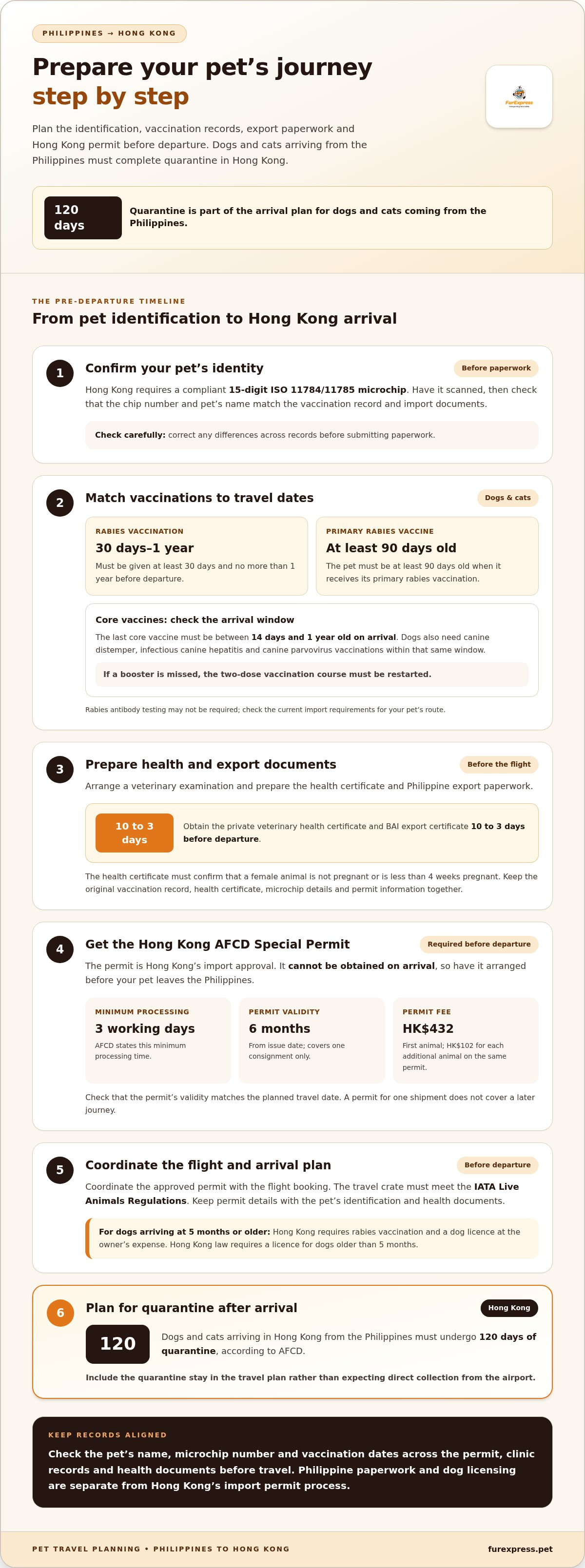
The AFCD permit must be arranged before your pet leaves the Philippines; it can’t be obtained on arrival in Hong Kong. For pet relocation from the Philippines to Hong Kong, plan to handle the permit application and its fee before the flight. Dogs and cats arriving from the Philippines must also undergo 120 days of quarantine, according to Hong Kong’s Agriculture, Fisheries and Conservation Department (AFCD).
It’s understandable to want a clear picture of the paperwork, vaccinations and costs before planning pet relocation from the Philippines to Hong Kong. This guide explains when the AFCD charge is due, which key documents and vaccination requirements apply, and what quarantine means for your pet’s arrival.
You’ll also learn how to read a relocation quote and distinguish permit and quarantine charges from transport and paperwork support. The steps are laid out in order, so you can plan ahead and know what to prepare for your pet’s journey.
Key Takeaways
- Arrange the Hong Kong AFCD Special Permit before your pet departs; it can’t be obtained on arrival.
- Dogs and cats arriving from the Philippines must undergo 120 days of quarantine in Hong Kong, according to the Agriculture, Fisheries and Conservation Department (AFCD), Hong Kong.
- Plan your pet’s microchip, vaccinations and health documents around the destination requirements and travel dates.
- Read relocation quotes carefully to understand which transport and paperwork services they cover, and whether quarantine charges are separate.
- Start planning early so permit processing, airline arrangements and quarantine preparation can be handled in sequence.
Relocation paperwork, permits and vaccinations
For a pet travelling to Hong Kong, prepare the destination permit, health paperwork and vaccination records before booking travel. The AFCD Special Permit must be obtained before departure, and quarantine is part of the arrival plan.
Permit Applications and Validity
The AFCD Special Permit is the Hong Kong import approval for the animals listed on one shipment. It is valid for 6 months from its issue date and covers one consignment only, so check that its validity matches the planned travel date. According to Agriculture, Fisheries and Conservation Department (AFCD), Hong Kong, the fee is HK$432 for the first animal and HK$102 for each additional animal on the same Special Permit.
Keep the permit details with the pet’s identification and health documents. A permit for one shipment does not cover a later journey. Philippine import paperwork and dog licensing are separate matters from Hong Kong’s import permit process; follow the requirements that apply to the direction of travel.
Approval Timing and Quarantine
How long does Hong Kong pet import approval take, and when should owners apply? AFCD states a minimum processing time of 3 working days, but owners must obtain the Special Permit before the pet departs. Apply with enough time to resolve document issues and coordinate the approved permit with the flight booking.
Dogs and cats arriving in Hong Kong from the Philippines must undergo 120 days of quarantine, according to Agriculture, Fisheries and Conservation Department (AFCD), Hong Kong. Include this stay in the travel plan rather than treating arrival as a direct collection from the airport.
Vaccination records need to match the pet’s identity and travel dates. Hong Kong requires a compliant 15-digit ISO 11784/11785 microchip. The rabies vaccination must be given at least 30 days and no more than 1 year before departure. A primary rabies vaccination requires the pet to be at least 90 days old.
Check the timing of other core vaccinations as well. The last core vaccine must be between 14 days and 1 year old on arrival. Dogs also need vaccination against canine distemper, infectious canine hepatitis and canine parvovirus within that same arrival window. If a booster is missed, the two-dose vaccination course must be restarted.
Keep a clear file with the permit, microchip details, vaccination record and health certificate. For a dog arriving at 5 months or older, Hong Kong requires rabies vaccination and a dog licence at the owner’s expense. Hong Kong law also requires a licence for dogs older than 5 months. Check that names, microchip numbers and dates match across documents before submitting the application. A difference between records can delay review or disrupt the travel sequence.
Philippines vaccination requirements for dogs and cats
For this route, Hong Kong’s entry rules set the core vaccination, identification and health-document checks. Dogs and cats need a compliant microchip and rabies vaccination. Check the applicable entry requirements before travel, as testing requirements may vary.
Use Hong Kong’s requirements to plan the journey. The crate must meet the IATA Live Animals Regulations, and the microchip details must match the paperwork.
Microchip and Rabies Requirements
Hong Kong requires an ISO 11784/11785-compliant, 15-digit microchip. Have the chip scanned and compare its number with the vaccination record and import documents before submitting paperwork. A mismatch can make it harder to connect the records to the correct pet.
For dogs and cats, the rabies vaccination must be given at least 30 days and no more than 1 year before departure. A primary rabies vaccination requires the animal to be at least 90 days old. Rabies antibody testing may not be required, but check the current import requirements for your pet’s route.
Vaccination Timing and Health Certificates
The timing of other vaccines matters too. The last core vaccine must be between 14 days and 1 year old on arrival. Dogs need canine distemper, infectious canine hepatitis and canine parvovirus vaccinations within that same period. If a booster is missed, the two-dose vaccination course must be restarted.
Schedule a veterinary examination and prepare the health certificate and Philippine export paperwork before the flight. The certificate must confirm a female animal isn’t pregnant or is less than 4 weeks pregnant. Obtain the private veterinary health certificate and BAI export certificate 10 to 3 days before departure.
Philippine vaccination guidance for pets travelling into the country is different from Hong Kong’s import rules. Dogs travelling to the Philippines are advised to receive C3 and Leptospirosis vaccines at least 14 days before arrival. Cats travelling to the Philippines are advised to receive F3 at least 14 days before travel. These country-specific recommendations don’t replace the vaccination schedule for Hong Kong.
Keep the original vaccination record, health certificate, microchip details and permit information together. Check the animal’s name, chip number and vaccine dates across every document. If the chip number differs between the clinic record and permit application, correct the records before travel instead of relying on airline staff to resolve the mismatch.
For help coordinating Philippine export paperwork alongside your pet’s journey, pet travel and paperwork support can be a practical next step.
Is quarantine unavoidable when moving a pet from the Philippines to Hong Kong?
Yes. Dogs and cats arriving in Hong Kong from the Philippines must undergo 120 days of quarantine, according to Agriculture, Fisheries and Conservation Department (AFCD), Hong Kong. Veterinary checks and accurate export documents help prepare the journey, but they don’t remove this quarantine requirement.
Veterinary Checks and Health Certificates
Arrange a veterinary examination before departure, and make sure the health certificate matches your pet’s identity and travel records. It should reflect the animal’s actual health status and include matching microchip details. Ask the examining veterinarian to check that names, dates and identification numbers are consistent across the paperwork.
Timing matters: obtain the private veterinary health certificate and BAI export certificate 10 to 3 days before departure. A certificate prepared too early may not fit the travel schedule, while errors can require corrected documents. Owners should coordinate the examination, certificate preparation and flight date as one sequence.
Philippine BAI Export Certificates
The Philippine Bureau of Animal Industry (BAI) export certificate is part of the departure paperwork for a pet leaving the Philippines. Prepare it alongside the health certificate. It does not replace veterinary records or Hong Kong’s import permit. Check that the pet’s microchip number and vaccination details match across the documents.
Keep copies together with the original records for the travel process. If the BAI certificate lists an identification number that differs from the health certificate, resolve the mismatch before departure. The BAI export certificate supports the Philippine export process, while Hong Kong’s entry permit is a separate requirement.
Delay, Refusal, and Quarantine Risks
Common problems include incomplete paperwork, inconsistent identification details, missed vaccination timing or a health certificate that changes after preparation. A changed or incomplete Hong Kong health certificate can lead to up to 6 months of quarantine. Review every document against the pet’s chip number and travel dates before submitting or presenting it.
Quarantine is not avoided by using a different flight arrangement on this route. The 120-day requirement applies to dogs and cats arriving from the Philippines, while document problems can add further consequences. A pet showing signs of illness may also require veterinary assessment before travel; keep the certificate consistent with the examination.
USDA health certificates and endorsements concern pets travelling from the United States, not Philippine-origin pets. For example, a pet travelling from the Continental United States needs a VC-DC2 certificate issued by a USDA-accredited veterinarian within 14 days of departure. That US-specific form does not replace Philippine BAI export documents.
You may encounter relocation partners that highlight professional credentials. Any membership or certification is separate from the import permit, veterinary certificate and BAI paperwork. For this route, check that the records accurately identify your pet from the Philippine examination through arrival in Hong Kong.
Is the quarantine fee included in a pet relocation quote?
Don’t assume a relocation quote includes Hong Kong quarantine charges. Read the itemized scope and separate government quarantine costs from flight booking, paperwork and handling. This makes it clear which charges cover the journey and which relate to the required stay after arrival.
Hong Kong government quarantine centres charge by the day, with different rates for dogs and cats. The total depends on your pet’s species and length of stay. Treat the centre’s charge as a separate budget item, not an airline fee or export-document charge.
Compare quotes by looking for clearly separated cost categories:
- Flight transport and airline handling
- Permit and export paperwork
- Arrival transfer and inspection arrangements
- Government quarantine-centre charges
A quote that groups several tasks under one transport total may not make every outside charge clear. Look for the service scope and exclusions, especially whether the quarantine-centre payment is included or paid separately. Transportation can be arranged while the government facility bills separately for the stay.
Flight Booking and Transport Options
Hong Kong-bound pets normally travel as manifest cargo. After arrival and inspection, they’re transferred onward rather than collected in the arrivals hall. Plan for the handover and destination facility, not a reunion at the passenger baggage area.
In-hold travel may have different conditions, so check whether the pet must travel alongside its owner. Cargo shipments may travel separately, so coordinate the pet’s booking with the permit, paperwork and arrival arrangements. The airline and route determine which transport options are accepted.
Arrival Declarations and Transit Planning
Plan the import declaration and flight records around the actual route. International pet shipments must clear customs at the first airport of entry. A transit point can affect the sequence of handling and document checks, even when Hong Kong is the final destination.
Before booking, map each flight segment, the first airport of entry and the onward transfer. Keep your pet’s permit and health documents ready for the relevant checks. If the itinerary changes, update the transport arrangements so the documents still match the route and shipment.
Ground transfer is another distinct step. The arrival inspection and onward movement connect the flight to the quarantine facility, so include handover details alongside the airline booking. For example, cargo arrivals need a planned transfer after inspection, while an owner travelling in-hold still needs to account for the pet’s separate arrival process.
For a clear comparison, ask for a quote that distinguishes transport, paperwork and quarantine-centre charges. This helps you budget for the full journey without treating an airline booking as an all-inclusive relocation arrangement.
International pet relocation services
International pet moves involve airline planning, export preparation and arrival arrangements. For pet relocation from the Philippines to Hong Kong, compare the service scope, not just the transport label.
Relocation Company Services
Relocation services may coordinate flight bookings, export documents, import-permit preparation and arrival handovers. Some arrange cargo transport, while others assist with in-cabin or excess-baggage travel, subject to airline acceptance and route. Check what each service covers, including who manages documents and the transfer after landing.
Pet relocation from the Philippines to Hong Kong is described as taking 4-6 months. That planning window can include permit preparation, vaccination timing, flight arrangements and quarantine coordination. Begin by matching your pet’s documents and travel needs to the service scope, then align the proposed itinerary with the import requirements.
Comparing Relocation Services
Compare quotes against the same practical tasks. One may focus on airline cargo booking, while another may include export paperwork or import assistance. Separate these elements to see what is arranged before departure and what continues through arrival.
Check whether the service scope explains how the flight is booked, which documents are prepared and how your pet reaches its next destination. Also distinguish airline transport from quarantine accommodation. A relocation service can coordinate travel steps without operating the quarantine facility.
Use this comparison when reviewing a proposed plan:
- Transport mode: identify whether the plan uses cargo, in-cabin travel or excess-baggage assistance, subject to route and airline rules.
- Paperwork: identify responsibility for Philippine export documents and Hong Kong import-permit preparation.
- Flight route: list each flight segment and the first airport of entry, where international shipments clear customs.
- Arrival handover: clarify how inspection and onward transfer fit into the itinerary.
- Separate charges: distinguish transport and paperwork from government quarantine-centre charges.
Crate preparation is another useful comparison point. Pet travel crates must meet the IATA Live Animals Regulations. The airline booking and crate details need to align, so provide accurate information about your pet and its crate when planning the shipment.
Choose a plan that shows the sequence from Philippine export to arrival in Hong Kong. A clear itinerary outlines the flight arrangement, document responsibilities and handover steps. It should keep quarantine arrangements separate from airline transport, since the required stay is handled apart from the journey itself.
For help organizing international pet travel arrangements, start with your pet’s route, size and preferred transport mode.
FurExpress: Domestic In-Cabin Pet Travel
FurExpress helps owners plan pet journeys through International In-Cabin Pet Travel, International Pet Cargo Transport and Pet Excess Baggage Assistance. For a Hong Kong move, the right transport option depends on the route and airline requirements, while the required quarantine stay remains a separate arrival arrangement.
Domestic In-Cabin Pet Travel is intended for domestic journeys. For international travel, FurExpress coordinates the relevant transport and paperwork steps as stated in the written quotation, helping owners focus on preparing their pet and coordinating the schedule. Veterinary care and quarantine accommodation are separate from these travel services.
To discuss travel arrangements for your pet, contact FurExpress through its website.
Plan the next stage of your pet’s move
A move is easier to manage when the travel plan starts with your pet’s needs, not just the departure date. Consider how your pet handles travel, which transport arrangement suits the journey, and how you’ll stay organized through preparation and arrival. This is a useful starting point for planning pet relocation from the Philippines to Hong Kong.
FurExpress offers Domestic In-Cabin Pet Travel, International In-Cabin Pet Travel and International Pet Cargo Transport. The appropriate service depends on the route and travel arrangement you need. Share your plans and your pet’s travel requirements to discuss the next steps.
Contact FurExpress about your pet’s relocation when you’re ready to plan. A clear starting point can help you prepare for the journey with care and confidence.
Frequently Asked Questions
Do I pay AFCD before the flight?
Yes. Arrange the AFCD Special Permit and pay its fee before departure. The permit must be obtained before your pet leaves and can’t be issued on arrival. It applies to one consignment, so make sure it matches the shipment you’re planning. Keep the permit details with the travel documents and ensure the planned flight falls within its validity period.
Do the documents need DFA authentication?
DFA authentication should be treated as a document-specific requirement, not assumed for every paper in the file. Travel guidance recommends confirming whether it applies and checking Hong Kong’s current requirements around 30 days before departure. Review the actual documents being submitted, including the health and export certificates. That helps you identify any authentication step early enough to address it before the flight arrangements are finalized.
How can you avoid paying extra?
Avoidable costs can be reduced by matching the paperwork, vaccination records and flight details before submitting applications or confirming bookings. Compare your pet’s identification and travel dates across each document, and provide accurate crate details for the airline. Ask for a written breakdown of the relocation service, government charges and quarantine arrangements. Quarantine is required for this route, so it isn’t an optional charge.
How long does the whole process take?
Allow a planning window of 4-6 months for a move from the Philippines to Hong Kong. Quarantine-space availability can also affect the schedule: government-centre waits are about 3 months for dogs and 6 months for cats. Work backward from the intended travel date and coordinate the permit, veterinary paperwork, flight booking and quarantine arrangements as connected steps, rather than treating the flight date as the only deadline.
Short answer: how much does pet relocation to Hong Kong cost?
FurExpress provides a free written quote, with no obligation to book. The final cost depends on the route, airline, pet’s size and breed, crate requirements, permits, veterinary or laboratory services, airport handling and any optional pickup or delivery. Government charges, including quarantine-centre fees, are separate unless the written quotation explicitly includes them. This breakdown helps you compare the scope without assuming a flat rate.
What are Hong Kong's current pet import requirements for dogs and cats from the Philippines?
Dogs and cats need an AFCD Special Permit, an ISO-compliant microchip, valid vaccination records and health documents. Hong Kong requires dogs and cats arriving from the Philippines to undergo 120 days of quarantine, according to the Agriculture, Fisheries and Conservation Department (AFCD), Hong Kong. Check that the microchip number appears consistently across the pet’s records, permit application and health certificate before travel.
Does Hong Kong classify the Philippines as a high-risk country for rabies, and what quarantine rules apply?
For owners travelling on this route, the key practical rule is that Philippine-origin dogs and cats must undergo 120 days of quarantine in Hong Kong, according to the Agriculture, Fisheries and Conservation Department (AFCD), Hong Kong. Plan around that requirement rather than assuming vaccination records remove the stay. Keep the quarantine schedule connected to the flight plan, since the animal’s arrival and onward transfer need coordination.
What documents and import permits are needed to bring a pet from the Philippines to Hong Kong?
Prepare the Hong Kong AFCD Special Permit, your pet’s microchip and vaccination records, a veterinary health certificate and the Philippine BAI export certificate. Keep the permit separate from Philippine export paperwork, as each serves a different part of the journey. Check that your pet’s identity and travel details match across the documents, then keep them accessible for airline handling, inspection and arrival processing.
