
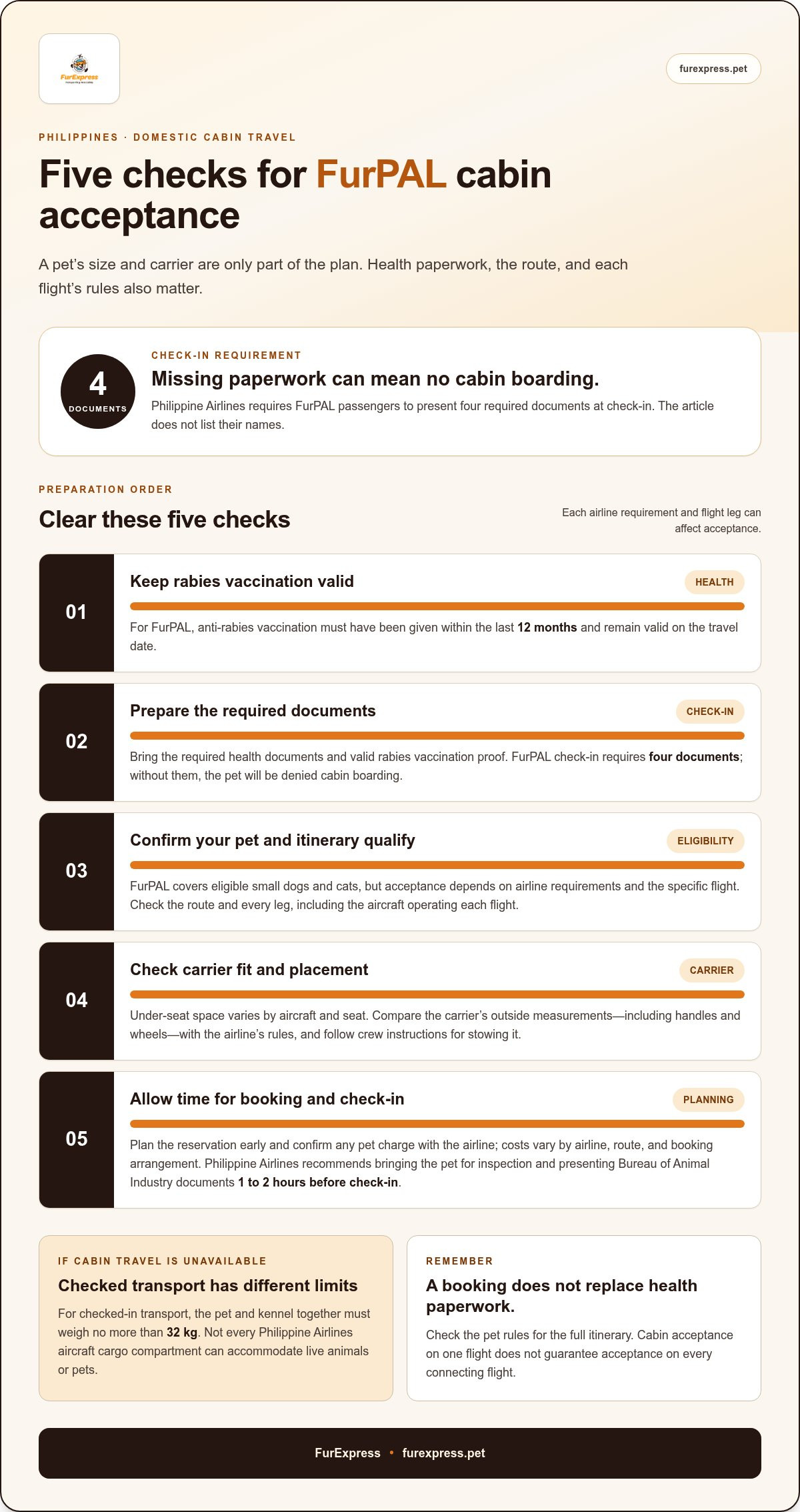
A cabin booking doesn't replace health paperwork. For pet in-cabin flights in the Philippines, Philippine Airlines requires FurPAL passengers to present four (4) documents at check-in; otherwise, the pet will be denied cabin boarding. A FurPAL pet also needs a valid anti-rabies vaccination given within the last 12 months and valid on the travel date.
It’s natural to focus first on your pet’s size and carrier, but vaccination validity and required documents matter too. Clarifying the requirements early can make it easier to prepare for travel day.
This guide explains which small pets may travel in the cabin and how to check carrier rules, limits, reservation deadlines, and health documents. It also distinguishes cabin travel from checked baggage and cargo, so you can identify what applies to your trip.
Key Takeaways
- Cabin eligibility depends on the airline’s pet rules, so review the carrier requirements and travel limits before choosing a flight.
- Keep your pet’s anti-rabies vaccination valid on the travel date; for FurPAL, it must have been given within the last 12 months.
- Prepare the required health documents ahead of check-in. FurPAL passengers must present four documents or their pet will be denied cabin boarding.
- Plan the reservation early and allow time to arrange any required paperwork before departure.
- For U.S.-bound travel, note that updated U.S. Centers for Disease Control and Prevention dog-importation regulations took effect on August 1, 2024.
In-cabin travel for small dogs and cats on domestic flights
Domestic cabin travel means your pet stays with you in the passenger cabin, subject to airline rules. For flights within the Philippines, check pet eligibility, the route, carrier requirements, booking, and documents.
PAL FurPAL is Philippine Airlines’ program for eligible pets travelling in the cabin. It covers qualifying small dogs and cats, but acceptance depends on the airline’s requirements for the pet and the specific flight. A valid anti-rabies vaccination must have been given within the last 12 months and remain valid on the travel date.
Domestic route coverage means pet acceptance depends on the itinerary and the aircraft operating each flight. Direct and connecting routes may involve different aircraft, each with its own pet rules. Check every leg before booking, since cabin acceptance on one flight doesn’t guarantee acceptance for the entire trip.
Can pets travel in the cabin on international flights departing from or arriving in the Philippines? Some airlines allow in-cabin pet travel on international routes, but the airline’s rules and destination requirements apply. The U.S. Centers for Disease Control and Prevention states that updated U.S. dog-importation regulations took effect on August 1, 2024; this concerns entry into the United States, not domestic Philippine cabin eligibility.
In-Cabin Pet Costs
In-cabin pet cost is the charge for carrying an eligible pet in the passenger cabin. The total varies by airline, route, and booking arrangement, so there’s no single fee for the Philippines. Ask about the airline’s charge when arranging the pet reservation, and distinguish it from your ticket fare and any paperwork costs. Don’t assume a fee until the airline confirms it.
Airport Check-In and Boarding Steps
Pet check-in is the airport process for presenting your pet, carrier, and travel documents for acceptance. Bring the required health documents, including valid rabies vaccination proof, and keep them ready with your travel papers. Philippine Airlines recommends bringing the pet for inspection and presenting Bureau of Animal Industry documents 1 to 2 hours before check-in.
At the counter, follow the airline’s instructions for document review and pet inspection. Keep your pet secured in the approved carrier in the airport, then follow staff directions when boarding. FurPAL passengers must present four required documents at check-in, or their pet will be denied cabin boarding.
Cabin Restrictions, Risks, and Alternatives
Cabin restrictions are airline rules that may prevent a pet from travelling beside its owner. The airline may refuse cabin travel if the pet, carrier, route, or flight doesn’t meet its requirements. Confirm eligibility and paperwork before travel day to reduce the risk of disrupting your itinerary.
Ask about another flight or an accepted transport option if cabin travel is unavailable. Checked transport is different from cabin travel: the pet and kennel together must weigh no more than 32 kg for checked-in transport. Not every Philippine Airlines aircraft cargo compartment can accommodate live animals or pets, so that option depends on aircraft capability.
Pet carrier placement under the seat
Under-seat placement means stowing the pet carrier beneath the seat in front during the flight, when the airline permits it. Space varies by aircraft and seat, so a carrier that fits one itinerary may not fit another.
In-cabin carrier specifications are the airline’s rules for carrier size and design. Don’t assume a soft-sided bag or a carrier marketed for air travel will fit every aircraft. Compare the airline’s published limits with the carrier’s outside measurements, including handles, wheels, and anything else that adds height or width.
Measure the carrier in the configuration you plan to use for travel. A folded blanket or attached pocket can change its profile. Check its length, width, and height against the applicable airline rules, and keep the model details handy when reviewing your booking.
Carrier placement is where the carrier must be during taxi, takeoff, and landing. Follow the cabin crew’s directions. Don’t plan to put it on a seat, in an aisle, or in an overhead bin unless staff specifically directs you to do so. Leave enough under-seat space to stow it as required.
Before travelling, practise the full sequence at home. Place your pet inside, close every opening, and slide the carrier beneath a table or chair to get a realistic sense of the movement. This can reveal a stiff frame, bulky handle, or carrier that catches in a confined space.
Check the carrier from your pet’s perspective, too. Your dog or cat should be able to settle naturally without equipment pressing against its body. Make sure the fasteners work, the seams are secure, and the carrier can be carried without sharp tilting. Keep familiar bedding compact so it doesn’t block the opening or reduce usable space.
At the airport, bring the same carrier you measured and practised with. A last-minute replacement may have a different shape, even if its label lists similar dimensions. Keep your pet secured in the terminal, and wait for the crew’s instructions before positioning the carrier at your seat.
For in-cabin pet travel planning, organize the itinerary and carrier details together. That makes it easier to compare the carrier’s fit with the airline’s cabin rules before departure.
Pet age, weight, and per-flight limits
Age eligibility means the airline’s minimum-age requirement for cabin travel. Check the rules for the specific program before choosing a flight. A small body size alone doesn’t establish age eligibility. If you’re travelling with a young puppy or kitten, have its birth date ready when arranging the booking.
Pet weight is one measurement an airline may use to decide whether a pet can travel in the cabin. Weigh your pet and carrier separately, then together, so you have all the figures available. Don’t use your pet’s weight alone to assess eligibility. Carrier dimensions and airline rules matter too.
For Philippine Airlines, distinguish cabin travel from checked-in transport when comparing weight requirements. The checked-in weight limit doesn’t necessarily apply to cabin travel. Ask which measurement the cabin program uses and whether it includes the carrier. Record the answer with your flight details instead of relying on a general figure from another airline.
Per-flight limits are the airline’s rules on how many pets it accepts on a particular flight. Acceptance on one segment doesn’t automatically apply to another. For a connection through a major domestic hub, treat each flight as a separate step in your planning when organizing pet in cabin flights Philippines.
Before booking, note the details the airline needs to assess your pet: species, age, combined weight, carrier dimensions, and each flight number. Provide the information for every segment. If you later change the aircraft or itinerary, review the pet arrangement again. Changes to your passenger booking can affect the flight details linked to your pet.
Keep your pet’s age and weight information consistent across the booking and travel documents. For example, use the same birth date when making the reservation and presenting paperwork at the airport. Reweigh your pet with the carrier if either has changed since your first measurement.
Acceptance should apply to the actual itinerary, not just the route name. Flights between the same Philippine destinations may use different aircraft or connections on different schedules. Ask for the pet’s acceptance to be recorded against each flight, and keep the booking reference handy for check-in.
These checks separate three decisions: whether your pet meets the age requirement, whether its combined weight fits the cabin rule, and whether space is available on every flight. Confirm each point before finalizing the itinerary, especially if travelling with a young pet or connecting between domestic flights.
Pet reservation deadlines and booking methods
A pet reservation is the airline’s separate record that your animal will travel on a particular flight. A passenger ticket alone doesn’t confirm that the pet has been accepted. Arrange the pet booking with your itinerary in view, and keep the airline’s confirmation with your travel documents.
A booking method is the channel an airline uses to receive and confirm a pet request. Follow the airline’s stated process rather than assuming an online passenger booking also reserves space for your pet. Have your route, flight details, pet’s species, and carrier information ready when making the request.
For a domestic itinerary, take these steps before considering the booking complete:
- Choose the flights. Write down each flight number and any connection. A pet arrangement for one segment does not establish acceptance on every segment.
- Submit the pet request. Use the airline’s designated booking channel and provide the pet and carrier details it asks for.
- Keep the response. Save the pet reservation confirmation with your passenger booking information.
- Review itinerary changes. If a flight, connection, or aircraft changes, revisit the pet arrangement for the affected segment.
A booking deadline is the latest time to submit a required request or document to the airline. The process varies by route and paperwork, so identify the requirements while planning rather than waiting until airport check-in.
For Philippine Airlines flights involving the United States, Department of Transportation forms must be submitted at least 48 hours prior to departure. This requirement applies to those flights, not automatically to domestic Philippine travel. Keep the submission record with the itinerary so the relevant forms can be found easily.
For a connecting trip, keep the details together: flight numbers, dates, pet reservation status, carrier information, and required forms. Compare the airline’s confirmation with your final itinerary. If a schedule change gives you a different flight number, update your notes and address the pet booking for that segment.
Submit information carefully. Use the same pet description and travel details in your request and supporting documents. A mismatch, such as a different route or pet description, can make it harder to match the reservation to the correct journey. Keep copies, including any airline response, accessible on travel day.
Plan the request alongside the passenger booking, then check each flight segment and deadline before departure. This helps distinguish a confirmed passenger seat from an accepted pet reservation and reduces the chance of overlooking route-specific forms.
Health certificates and vaccination documents
A health certificate records information about a pet’s health for travel. Vaccination proof identifies the vaccine and when it was administered. For Philippine Airlines FurPAL, passengers must present four required documents at check-in, or their pet will be denied cabin boarding. For pet in cabin flights in the Philippines, prepare the full document set rather than relying on a vaccination record alone.
Keep the required papers together and compare them with the airline’s instructions before leaving for the airport. Each document serves a different purpose, so don’t assume one certificate replaces another. Check that the papers belong to the travelling pet and are ready to present together at check-in.
Rabies vaccination validity means the anti-rabies vaccination remains current on the travel date. For FurPAL, the vaccination must have been administered within the last 12 months and still be valid on the travel date. Check the dates printed on the record against the flight date. A past appointment or a note on a calendar isn’t a substitute for the vaccination document.
Reviewing documents can help catch mismatches before check-in. Compare the pet’s identifying details across the vaccination record and other travel papers. If a name or description differs, keep the documents together for staff to review as a set. For pet in-cabin flights in the Philippines, organized records make it easier to show which papers apply to your pet and itinerary.
Bureau of Animal Industry documents are official papers that may form part of pet travel paperwork. Philippine Airlines recommends presenting these documents and bringing the pet for inspection 1 to 2 hours before check-in. Keep the papers accessible, not packed beneath luggage, and bring the pet along for the recommended inspection.
At the airport, present the documents when requested and keep your pet available for inspection. Store the papers together in a folder or envelope, separate from items you may need to open during check-in. This makes it easier to present the vaccination record and related travel documents together.
For an international itinerary, distinguish airline cabin acceptance from destination entry paperwork. A pet may meet the airline’s cabin requirements but still need documents for the destination country. Keep the papers grouped with the correct itinerary, especially if your journey includes a connection or more than one destination.
Before departure, check vaccination dates, assemble the four FurPAL documents, include relevant Bureau of Animal Industry papers, and plan around the inspection recommendation. For help organizing pet travel paperwork, bring the route and available records together.
FurExpress: International Pet Cargo Transport
FurExpress provides International Pet Cargo Transport when cabin travel isn’t suitable for your pet or itinerary. This option may suit international journeys where airline cabin rules, the route, or travel arrangements call for cargo transport.
For other travel needs, FurExpress also offers Pet Excess Baggage Assistance, Rabies Titer Testing Assistance, and Pet Import Assistance to the Philippines. These services can help with transport arrangements and related travel preparation, while veterinary care and accommodation remain separate needs.
Share your pet’s route and travel plans with FurExpress to discuss the relevant assistance. You’re welcome to contact FurExpress about pet travel.
Choose the travel plan that fits your pet
Your next step is to match the travel arrangement to your pet, route, and comfort. If you’re planning pet in cabin flights in the Philippines, consider whether cabin travel suits the full itinerary. FurExpress offers Domestic In-Cabin Pet Travel and International In-Cabin Pet Travel, subject to airline acceptance and route, as stated in the written quotation.
If cabin travel doesn’t suit the trip, FurExpress also offers International Pet Cargo Transport, as stated in the written quotation. The right option depends on the route and airline transport rules. FurExpress can help you consider the available arrangement with your pet’s needs in mind.
Share your planned route and travel details to take the next step. Contact FurExpress about pet travel and discuss which travel assistance suits your journey. With a clear plan, you can prepare for the trip one decision at a time.
Frequently Asked Questions
Which airlines in the Philippines allow pets in the cabin?
Philippine Airlines has the FurPAL program for eligible pets, but cabin acceptance depends on the airline and route. FurExpress coordinates pet travel with Philippine Airlines and Cebu Pacific, among other airline partners, subject to airline acceptance and route, as stated in the written quotation. A partnership doesn’t mean every flight accepts cabin pets. Confirm the specific flight’s pet rules and reservation before choosing your itinerary, and check each segment of a connecting journey separately.
What are the maximum pet and carrier weight and size limits for flights in the Philippines?
There isn’t one cabin weight or carrier-size limit that applies to every Philippine flight. Airline rules, aircraft, and whether the pet travels in the cabin or as checked transport affect the applicable limit. For checked-in transport, the pet and kennel together must weigh no more than 32 kg. Don’t apply that checked-transport figure to cabin travel; compare your pet and carrier with the chosen airline’s cabin requirements.
Which pet species and breeds are allowed in the cabin on Philippine domestic flights?
Philippine Airlines’ FurPAL program covers eligible small dogs and cats on domestic flights. This doesn’t establish cabin eligibility for other species or every breed. Before choosing a flight, provide the airline with your pet’s species and breed, along with its size and carrier details. This gives the airline the information needed to assess your pet for the specific flight, rather than relying on assumptions based only on breed name or small size.
How do I book a cabin pet and notify the airline in advance?
Contact the airline through its pet-booking process and request acceptance for every flight segment. Have your itinerary, pet details, and carrier information ready. Keep the airline’s response with your booking, then revisit the pet arrangement if your flights change. For Philippine Airlines flights involving the United States, submit Department of Transportation forms at least 48 hours before departure. That deadline is route-specific, not a general domestic booking deadline.
What carrier requirements apply to pets flying in the cabin in the Philippines?
The carrier must meet the airline’s cabin rules and fit the assigned under-seat space when required. Check its outside dimensions, including handles and other protruding parts, against the specific aircraft’s limits. Philippine Airlines states that pet crates must comply with International Air Transport Association regulations, but that alone doesn’t confirm cabin-carrier acceptance. Share the carrier details when arranging your pet’s booking, and follow crew instructions onboard.
What documents, vaccinations, and permits are required for domestic flights with pets in the Philippines?
For Philippine Airlines FurPAL, bring the four required check-in documents and valid anti-rabies vaccination proof. The vaccination must have been given within the last 12 months and remain valid on the travel date. Philippine Airlines also recommends presenting Bureau of Animal Industry documents. Keep your pet’s details consistent across its records, and organize the paperwork by itinerary. The airline’s current document instructions determine which forms to prepare for your trip.

