
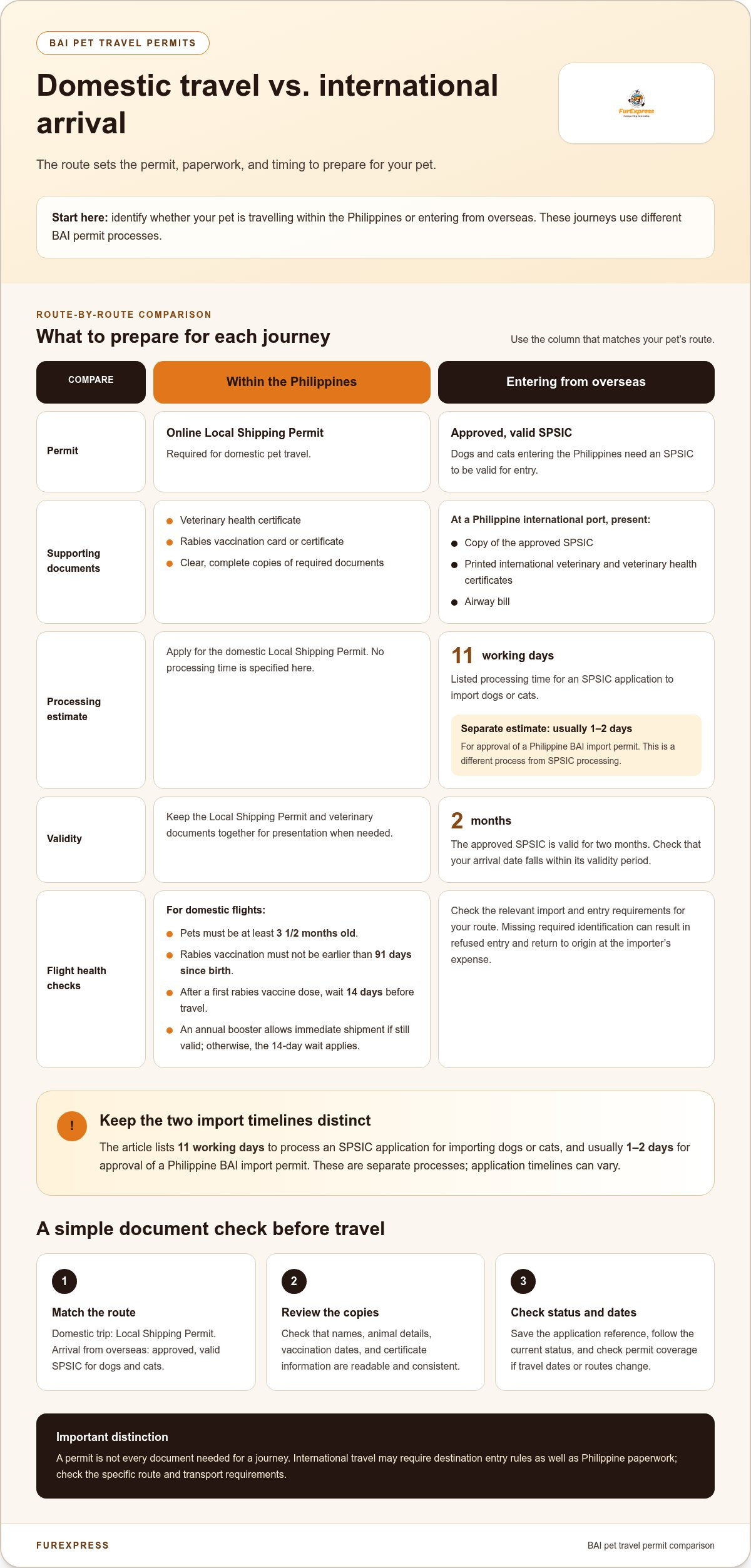
A BAI travel permit for pets depends on the journey. Dogs and cats entering the Philippines need an approved, valid SPSIC, which is valid for two months. Domestic pet travel requires an online Local Shipping Permit. Apply for the permit that matches your pet’s route, whether it is travelling within the country or arriving from overseas.
Permit applications can feel like a lot to manage alongside your pet’s comfort and safety. Clear, complete document copies support the process, and identifying the correct permit early helps you organise each step.
This guide explains how to apply, track your application, and check permit processing and validity. It also sets out which travel documents apply to domestic journeys and international arrivals, so you can prepare your pet’s paperwork in order.
Key Takeaways
- Prepare clear, complete document copies before applying, then use the application status to follow progress and manage any next steps.
- Allow for different processing timelines: an SPSIC application for importing dogs or cats takes 11 working days, while a Philippine BAI import permit usually takes 1-2 days for approval.
- Match your paperwork to the trip: domestic travel and international arrival have different permit and veterinary document requirements.
- For international travel, plan for the destination’s entry rules as well as Philippine export paperwork; one permit may not cover every document needed for the journey.
- Check the requirements for your transport mode and route before departure, since air, sea, and land journeys can involve different preparation steps.
Applying for, tracking, and managing applications
First, identify whether your pet is travelling within the Philippines or entering from overseas. The route determines which BAI application and supporting documents to prepare.
-
Identify Required Pet Documents
Choose the application that matches the journey: domestic travel requires an online Local Shipping Permit, while importation requires an SPSIC. For domestic trips, prepare the animal’s veterinary health certificate and rabies vaccination card or certificate. Keep clear, complete copies of all required documents, following the National Veterinary Quarantine Services Division’s advice.
-
Check Vaccination and Health Requirements
Check the animal’s age and rabies record before beginning a domestic flight application. Pets must be at least 3 1/2 months old for domestic flights, and rabies vaccination must not be earlier than 91 days since birth. A pet may travel 14 days after its first rabies vaccine dose. For an annual booster, immediate shipment is allowed if the vaccine remains valid; otherwise, the 14-day wait applies.
- Submit the application for the correct travel type, then save its receipt and reference details. For a Philippine import permit, allow for the listed processing timelines: a BAI import permit application usually takes 1-2 days for approval, while an SPSIC application for importing dogs or cats takes 11 working days to process. Application timelines can vary, so identify the relevant process before estimating when it may be ready.
Before submitting, compare each scanned or copied document with the original. Check that names, animal details, vaccination dates, and certificate information are readable and consistent. Missing pages or blurred dates can make an application harder to assess. Submit complete, legible copies rather than separate images that obscure important details.
- Track progress through the NVQSD application-status dashboard for applications handled there. Use the reference details saved at submission to locate the correct record, then read its current status rather than relying on an old screenshot. The dashboard’s application-status figures listed 82 applications for approval in 7 days. That figure describes dashboard records, not a promised approval time for an individual application.
Check the application status regularly as departure approaches. If the system requests action, compare the request with your submitted documents and provide the relevant correction or missing copy through the application process. Save each updated submission and note when you sent it, so you can distinguish the latest version from earlier paperwork.
- Treat the approved permit as a travel document, not just an application result. Confirm that the animal’s details and travel purpose match your plans, then keep the permit with its supporting records. For an import, the approved SPSIC must be valid for entry and is valid for two months. Align your arrival date with that period before finalising travel arrangements.
For domestic travel, keep the Local Shipping Permit and veterinary documents together for presentation when needed. A separate file for each animal helps prevent mixing certificates or vaccination records. Recheck the application status and documents after an itinerary change, particularly if the route or travel date differs from the original application.
Permit processing and validity
Without the required BAI documents, your pet’s paperwork cannot demonstrate compliance with the applicable travel requirements. For imported dogs and cats, missing required identification can result in refused entry and return to origin at the importer’s expense.
- Keep the processing estimate separate from the permit’s validity period. An application may be approved before departure, but approval alone does not mean the permit will still cover your travel date. Record the approval date, expiry date, and planned journey together. Check these dates against your travel plan.
- Read the permit when it arrives. Match the animal’s identifying details and travel purpose against the application and supporting documents. If a name, identification number, route, or other travel detail differs, don’t assume the record will update automatically. Keep the approved copy and application reference together for easy access.
- Use the application status to determine your next step. An in-progress status means the application has not reached a final result; approval means you should review the issued document carefully. If the system requests a correction, compare the request with your submission and respond with a clear, complete document. Save the revised file separately from the original.
- Base your timeline on the actual route. Domestic travel uses local shipping paperwork, while a dog or cat entering the Philippines needs an approved, valid SPSIC. These are separate permit processes, so one application’s status or approval does not determine the other. If the travel date changes, reassess the permit’s coverage and the documents required for the revised itinerary.
- Prepare a travel folder with the permit, veterinary health certificate, and rabies vaccination record where applicable. At a Philippine international port, importers must present copies of the approved SPSIC, printed international veterinary and veterinary health certificates, and the airway bill for validation. Keep digital copies as backup, but have the required printed records ready for arrival.
- For a domestic flight, bring the required BAI paperwork for presentation and inspection. Pet owners are advised to bring their pets for inspection 1 to 2 hours before check-in. Build that time into the airport plan, and keep the animal’s documents together so you can present them without sorting through unrelated records.
If permit documents and a domestic flight plan need coordination, explore pet travel planning support alongside your own document checks.
Which pets need a BAI veterinary health certificate or local shipping permit?
Start with the route. Domestic journeys within the Philippines use local shipping requirements, while dogs and cats entering the country need import paperwork. The permit type depends on the journey, not just the animal’s species.
- For domestic travel, identify each pet making the journey and prepare an online Local Shipping Permit application. This permit is required for domestic pet travel. Supporting documents include a veterinary health certificate and rabies vaccination card or certificate. Keep each animal’s records together so its application matches its health and vaccination documents.
Use the departure point and destination to classify the journey. A dog travelling between locations in the Philippines is making a domestic trip, even if the route includes multiple flights. The Local Shipping Permit is the relevant BAI travel document for this movement. Don’t substitute an import permit for a local application.
- For a dog or cat arriving from overseas, treat the journey as an import and prepare an SPSIC application. Every dog and cat entering the Philippines needs an approved, valid SPSIC. This import permit is separate from the online Local Shipping Permit for domestic travel. Keep the two application processes distinct, even if the same animal will later travel locally.
Match the import application to the supporting veterinary paperwork. Under BAI Memorandum Circular 43, series of 2020, the Philippines applies a one-SPSIC-per-one-international-veterinary-certificate/veterinary-health-certificate policy. The certificate and permit therefore need to correspond for the import journey. Keep copies aligned, rather than grouping unrelated animals’ records together.
- Check the animal’s identity and health records before assembling either application. Dogs and cats imported into the Philippines must have an ISO-compliant microchip for identification. Their veterinary health certificate must certify freedom from dangerous or communicable disease exposure and confirm required inoculations. Use the animal’s own records to ensure every document describes that pet.
For domestic travel, gather the veterinary health certificate and rabies vaccination record specified in the local requirements. Check that the animal’s details and vaccination information are legible. Don’t file one pet’s vaccination card with another pet’s application, even if both animals are travelling together.
- Keep domestic and import records separate when an itinerary combines both journeys. For example, a dog arriving internationally and then taking a domestic flight in the Philippines has an import stage and a local travel stage. The SPSIC covers entry requirements; the Local Shipping Permit applies to domestic travel. Organise the documents by stage and use the correct set for each application.
What are the rules for transporting pets by air, sea, or land in the Philippines?
Plan around the route, transport mode, and the animal’s records. The Philippines’ Department of Agriculture Administrative Order No. 05, series 2019 provides guidelines for local transport and shipment of live animals.
- For a domestic flight, check the pet’s age before booking. Dogs and cats must be at least 3 1/2 months old for domestic flights. The rabies vaccination must not be given earlier than 91 days since birth. These conditions affect whether the animal is ready to travel by air, so compare the birth date and vaccine record before setting the flight date.
If it’s the pet’s first rabies dose, allow 14 days before domestic travel. A dog or cat with an annual booster may be shipped immediately if that vaccine remains valid. If the booster is no longer valid, the 14-day wait applies. Check the card or certificate for the vaccine date and validity before departure.
- Prepare the documents for a domestic flight as a matching set. The local travel requirements list a veterinary health certificate and rabies vaccination card or certificate. Keep both records with the animal’s Local Shipping Permit, and check that the pet’s identifying details are consistent. At the airport, pet owners are advised to bring the animal for inspection 1 to 2 hours before check-in.
- For sea travel, first confirm the route and the carrier’s process for accepting animals. Administrative Order No. 05, series 2019 covers local transport and shipment of live animals, but the provided domestic flight age and rabies timing rules are specifically stated for flights. Keep the animal’s health and vaccination documents together, and don’t assume an air-specific age or timing detail automatically describes a sea journey.
Apply the same careful route check to land transport. Identify the departure point, destination, and any transfer, then keep the relevant permit and veterinary records accessible throughout the trip. This provides a national framework for local animal transport, but distinguish it from rules that apply specifically to domestic flights.
- If the animal is leaving the Philippines, check export timing separately from domestic travel. Pets leaving the country must be at least 4 months old. For pets shipped from the Philippines, rabies vaccination must be given at least 30 days and not more than 1 year before shipment. Use the shipment date to count backward and compare it with the vaccination record.
A domestic flight within the Philippines and an international departure are separate journeys. Keep their documents apart, even if the same animal travels by air for both. A local flight before an overseas departure, for example, still has its own domestic permit and inspection steps.
Does a BAI permit cover international travel, or are additional export documents required?
Use each permit for its specific purpose. A BAI document for Philippine procedures does not replace the destination country’s entry requirements or the documents needed for the full journey. For international departure, prepare for both Philippine export procedures and the rules that apply on arrival.
- Keep Philippine export paperwork separate from destination entry documents. Note the departure country, destination, and any transit points, then organise requirements by stage. The same animal may need documents for more than one authority. A domestic Local Shipping Permit does not cover an international departure, and an export document does not necessarily meet the destination’s entry rules.
- Check the pet’s eligibility against the Philippine departure requirements. Pets leaving the Philippines must be at least 4 months old. For pets shipped from the Philippines, rabies vaccination must be given at least 30 days and not more than 1 year before shipment. Compare the animal’s birth date and vaccination record with the planned shipment date before finalising arrangements.
- Build the health records around the actual departure date. Gather the vaccination record and veterinary documents for the animal, then check that identifying details match across each copy. Do not apply a rule for arrival in the Philippines to an export journey. For example, the 30-day health-certificate timing listed for pets arriving in the Philippines concerns arrival, not departure from the country.
- Check each transit arrangement separately. A new permit is required for a dog or cat transiting through another country if the airline is changed. Keep the itinerary consistent across booking and permit records, and identify any airline change before travel. Even when the airline does not change, consider destination and transit requirements separately.
- Assemble a departure folder for your pet’s journey. Keep applicable Philippine export paperwork, health records, vaccination evidence, and destination documents together. Use the animal’s name and identification details to distinguish its records from another pet’s. For journeys with multiple stages, arrange documents by stage so the right record is available at departure, transit, and arrival.
- Before travel, compare the final itinerary with the documents you prepared. A changed shipment date can affect the rabies vaccination timing, while a changed airline can affect transit paperwork. For help planning the connected travel steps, plan your pet’s international journey with support tailored to pet air travel.
FurExpress: Domestic In-Cabin Pet Travel
FurExpress helps pet owners plan domestic in-cabin air travel and manage the related Local BAI travel permit process. This support can help when you’re arranging a Philippine flight and want the travel paperwork and pet journey considered together.
You’ll still need to prepare your pet’s veterinary health certificate and rabies vaccination record, and follow applicable airport inspection steps. FurExpress coordinates travel arrangements and permit processing as stated in the written quotation; veterinary care remains with your pet’s veterinarian.
For an international journey, FurExpress also coordinates in-cabin travel, excess baggage assistance, and pet cargo transport, subject to airline acceptance and route, as stated in the written quotation. Choose the arrangement that fits your pet and itinerary.
For help planning domestic in-cabin travel, visit FurExpress.
Make the Next Travel Step With Care
A pet’s travel plan is easier to manage when paperwork and transport arrangements move forward together. Before booking, consider how your animal will travel, which documents need attention, and how each stage fits the plan. A BAI travel permit for pets is one part of preparation, not a substitute for arranging the journey itself.
FurExpress coordinates domestic and international in-cabin pet travel, as well as international pet cargo transport, subject to airline acceptance and route, as stated in the written quotation. These arrangements help you plan around your pet’s route and travel method while preparing the required paperwork. Choose support that fits the journey.
For a calm next step, contact FurExpress for pet travel help. With a clear plan in place, you can focus on preparing your pet for the journey ahead.
Frequently Asked Questions
What is a BAI travel permit for pets in the Philippines?
A BAI travel permit is a document for a specific pet journey. The permit depends on the route: domestic movement and entry into the Philippines use different application processes. A dog travelling within the Philippines needs local travel paperwork, while a dog arriving from overseas follows import requirements. Identify the journey first, then use the matching process and keep its records separate from documents for other stages.
What documents are required to apply for a BAI pet travel permit?
Required documents depend on whether your pet is travelling domestically or entering the Philippines. For a domestic trip, prepare a veterinary health certificate and rabies vaccination card or certificate. For an import application, organise the animal’s veterinary and vaccination records with its identification details. Keep each pet’s documents together and use clear copies that can be matched to the correct animal.
How do I apply for a BAI pet travel permit, and can I apply online?
For domestic travel, apply online for a Local Shipping Permit through the NVQSD system. For an imported dog or cat, submit an SPSIC application through the Philippine pet import permit application process and save your reference details. Use those details when checking the application status. Keep a copy of each submitted file so you can identify the version associated with the application if you need to review its progress.
How many days before travel should I apply for the permit?
Allow for the processing time that applies to your permit type. An SPSIC application for importing dogs or cats takes 11 working days to process. A Philippine BAI import permit application usually takes 1-2 days for approval. These timelines refer to different processes, so first identify which permit your journey requires. For an import, plan the application date alongside the permit’s validity and your intended arrival.
What are the BAI permit requirements for bringing a pet into the Philippines?
Every dog and cat entering the Philippines needs an approved, valid SPSIC. Prepare the animal’s veterinary health certificate, vaccination records, and ISO-compliant microchip identification. Keep the paperwork matched to the pet, especially when travelling with more than one animal. At the Philippine international port, have the required arrival documents ready for validation, including the airway bill, printed veterinary certificates, and approved permit.


