

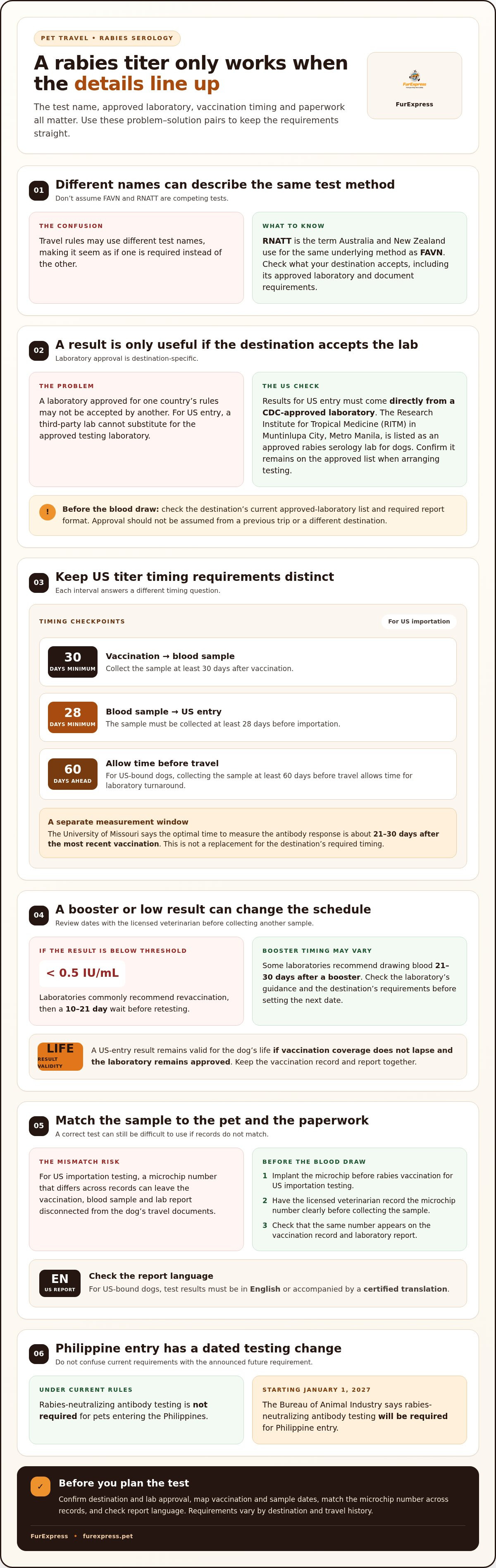
FAVN and RNATT aren’t competing tests: RNATT is the term Australia and New Zealand use for the same underlying method as FAVN. For dogs entering the United States, the Research Institute for Tropical Medicine in Muntinlupa is listed as an approved rabies serology laboratory. US results must be in English or accompanied by a certified translation. For pets entering the Philippines, rabies-neutralizing antibody testing isn’t required under current rules, but the Bureau of Animal Industry says it will be required starting January 1, 2027.
It’s understandable to focus on the test name when travel rules use different terms. But the destination’s accepted laboratory, timing requirements, and document language can matter just as much. A rabies titer test for pet travel is useful only when the result meets your destination’s requirements.
This guide explains how to choose an approved laboratory, how vaccination and booster timing can affect the blood draw, and when results may need a certified translation. You’ll also learn what to prepare before testing, so you can better coordinate the paperwork and travel timeline.
Key Takeaways
- Plan the microchip and rabies vaccination sequence before arranging the blood draw, since their order can affect whether the test is accepted.
- Map booster dates against your destination’s testing and travel windows to avoid disrupting the schedule.
- Choose a laboratory approved for your destination; for US entry, the result must come directly from a CDC-approved laboratory.
- Check the report’s language before travel, as US-bound dogs need English results or a certified translation.
Which labs are approved for a US-entry titer?
- Start with the microchip. For US importation testing, implant the dog’s microchip before rabies vaccination. The microchip number connects the vaccination record, blood sample, and laboratory report to the same dog. Ask the licensed veterinarian to record the number clearly before collecting the sample. If the records show different numbers, the results may not match the dog’s travel documents.
- Use a currently approved laboratory for a US-bound dog. Rabies serology results must come directly from a CDC-approved laboratory, not through a third-party laboratory. The Research Institute for Tropical Medicine in Muntinlupa City, Metro Manila, is listed as an approved rabies serology laboratory for dogs. Confirm that the laboratory remains on the approved list when arranging the test.
- Schedule the blood draw against the vaccination date. For US importation, the sample must be collected at least 30 days after vaccination and at least 28 days before entry. The University of Missouri states that the optimal time to measure the rabies antibody response is about 21 to 30 days after the most recent vaccination. These timing windows serve different purposes, so use the destination’s required dates.
- Allow time for processing. For US-bound dogs, collecting the sample at least 60 days before travel allows time for laboratory turnaround. A sample taken too close to departure may leave little room to receive and prepare the report before travel.
- Keep vaccination coverage continuous after testing. A US-entry rabies serology result remains valid for the dog’s life if vaccination coverage does not lapse and the laboratory remains approved. Keep the vaccination record and test report together, and make sure the microchip number matches both.
- For travel into the Philippines, source-country rabies vaccinations are honored for 3 years. That local validity rule is separate from US titer requirements, and Australia may apply its own travel timeline. Match the vaccination record and laboratory process to the destination.
Will a rabies booster reset my titer timeline?
Australia, Japan, and the EU for pets arriving from unlisted countries are examples of destinations that require a rabies antibody test. Requirements depend on the destination and the pet’s travel history.
Prepare the rabies vaccination record, microchip details, laboratory submission form, and blood sample collected by a licensed veterinarian. Then follow the destination’s testing and waiting periods before booking travel.
- Check whether the destination requires serology. Some dogs entering the United States may need rabies serology, depending on their vaccination documentation and travel history. A dog on the US titer track must have been in a CDC-listed high-risk country within the past 6 months.
- For Great Britain, plan the blood draw around the vaccination date. The sample must be taken at least 30 days after vaccination. After a successful result, the pet must wait 3 months from the sample date before travelling. The test remains valid if rabies vaccinations stay up to date.
- For the United States, a dog’s sample must be collected at least 30 days after its initial valid rabies vaccination and at least 28 days before importation. Keep vaccination coverage continuous so a previously valid result does not lapse.
- Ask the licensed veterinarian to review booster timing before another sample is collected. After a result below 0.5 IU/mL, laboratories commonly recommend revaccination and a 10 to 21 day wait before retesting. Some recommend drawing blood 21 to 30 days after a booster.
- For Philippine entry, dogs and cats need rabies vaccination even when their source country has never reported rabies. They must be at least 12 weeks old when vaccinated. Rabies-neutralizing antibody testing is not required for importation under current rules, but the Bureau of Animal Industry requires it starting January 1, 2027.
- Plan for the consequence of missing US serology: according to the Centers for Disease Control and Prevention, dogs entering the United States without valid rabies serology results must undergo a 28-day quarantine at a CDC-registered animal care facility. For help arranging testing and travel paperwork, use rabies titer testing assistance.
Approved laboratories for outbound travel and US entry
For outbound travel from the Philippines, the destination determines which laboratory and test result it accepts. For US entry, the laboratory must be CDC-approved.
- Match the laboratory to the destination before arranging testing. Approval under one country’s export rules does not automatically mean another country will accept the result. Confirm the destination’s approved-laboratory requirements and required test format before the blood sample is collected.
- For dogs, the Research Institute for Tropical Medicine in Muntinlupa City, Metro Manila, is listed as an approved rabies serology laboratory. Its location makes it a relevant option for pet owners arranging testing in the Philippines. Confirm that it remains listed for the destination when planning the test.
- For US entry, rabies serology results must come directly from a CDC-approved laboratory. A third-party laboratory cannot provide a result in place of the approved testing laboratory. Make sure the report identifies the laboratory that performed the test and matches your pet’s records.
- For outbound travel, check the destination’s approved-laboratory list for the period when your pet will travel. A laboratory that was previously approved but is no longer listed cannot provide a currently accepted result. Your pet will need a new result from a laboratory approved for that destination.
- Ask the veterinarian and laboratory to keep the sample details, submission form, and microchip information consistent. These records connect the test report to your pet and travel documents. Keep the final laboratory report with the vaccination record as you prepare for export.
- The cost in the Philippines, including sample shipping, depends on the testing arrangement, destination, and shipping requirements. The price depends on the case and is given after a quote request; the test, sample handling, and shipping are cost factors.
English-language test results and certified translations
- Check the report language against the destination’s entry rules before arranging testing. For dogs imported into the United States, rabies serology results must be in English or accompanied by a certified translation. If the laboratory issues the report in another language, plan for the translation alongside the final result.
- Review the original report with your veterinarian before using it for travel. Match the animal’s name and microchip number to the vaccination record and travel documents. Check that the report identifies the testing laboratory and includes the result, so details remain consistent across the paperwork.
- Use a certified translation, not an informal version prepared by a friend or translated through an app. Keep the original laboratory report with its translation. Presenting both makes it clear which result the translated document refers to and preserves the link between the report and your pet.
- Build translation time into the laboratory schedule. Kansas State University estimates a 10 to 14 calendar day turnaround for outbound FAVN testing, with timing varying by laboratory volume. That estimate covers testing, not translation. Arrange the next step after the report arrives, rather than leaving translation until the departure date.
- Keep the test report separate from other government paperwork. For dogs vaccinated outside the United States, the CDC Certification of Foreign Rabies Vaccination and Microchip form must be completed within 30 days of travel. It is not the rabies serology report or its translation. Keep each document clearly identified.
- Before bringing your pet to the airport, place the original report, certified translation when needed, vaccination record, and travel forms together. Arrange rabies titer testing assistance to help coordinate testing and related travel paperwork.
FurExpress: Domestic In-Cabin Pet Travel
FurExpress arranges domestic in-cabin pet travel for eligible pets traveling with their owners, subject to airline acceptance and route, as stated in the written quotation. For international travel, a titer test is only one part of the plan. FurExpress can help coordinate travel arrangements and documentation as stated in the written quotation.
For international journeys, FurExpress also arranges in-cabin travel, excess baggage assistance, and pet cargo transport, subject to airline acceptance and route, as stated in the written quotation. The suitable arrangement depends on your route and how your pet will travel. These transport options complement your preparations, but they do not replace destination-specific rabies testing or entry documents.
If you’re planning a domestic in-cabin trip, visit FurExpress to discuss your pet’s travel plans.
Set your pet’s travel plan in motion
Turn the test result into a practical travel plan by aligning it with your pet’s route and required documents. A rabies titer test for pet travel is one part of that plan. Keep the laboratory report, vaccination records, and travel arrangements together, so each detail is ready as the trip approaches.
FurExpress helps coordinate domestic and international pet travel, with services and inclusions set out in the written quotation. Share your route and pet’s travel details to request a written quotation and plan the next steps.
Contact FurExpress about your pet’s travel plans. A thoughtful start can make the journey ahead feel more manageable.
Frequently Asked Questions
Is FAVN the same as RNATT?
These terms refer to rabies antibody testing, but terminology varies by destination. Australia and New Zealand commonly use “RNATT,” while “FAVN” is another term pet owners may encounter. Check the destination’s required test name and report format in the laboratory instructions. The terminology can differ even when the underlying method is the same.
Is the titer process the same for leaving the US and entering the US?
No. For a pet leaving the United States, the destination sets the accepted laboratory, timing, and waiting rules. For a dog entering the United States on the titer track, CDC rules apply, including vaccination and sample timing. For example, a US-bound dog’s sample must follow the initial valid rabies vaccination. Start with the destination, then plan around its requirements.
The 180-day clock: blood draw date or lab receipt date?
It depends on the destination. For Australia, the 180-day residency period starts when the laboratory receives the sample. For Japan, the 180-day titer waiting period starts on the blood-sampling date. These are different start points, so record both dates: the veterinarian’s collection date and the laboratory’s receipt date. Use the one specified for your destination when calculating the earliest travel date.
What happens if my outbound titer doesn't pass in time?
If the result is below 0.5 IU/mL, laboratories commonly recommend revaccination, then another blood draw after a 10 to 21 day wait. That retest and any destination waiting period can affect the departure schedule. If the required result isn’t ready or doesn’t meet the destination’s threshold, plan around the applicable entry rules rather than travelling with an incomplete titer requirement. For US entry, missing valid serology can mean quarantine.
What is a rabies titer test for pet travel?
A rabies titer test for pet travel measures rabies-neutralizing antibodies in a blood sample after vaccination. The laboratory result helps a destination assess the animal’s antibody response against its entry requirements. A positive result indicates an adequate immune response following vaccination, but it isn’t proof that the animal is immune or protected from rabies exposure. The test report should be read alongside the destination’s rules.
What rabies antibody level is required for pet travel, and what units are used?
The required level depends on the destination. For EU and other pet travel schemes, at least 0.5 IU/mL is considered an adequate response to vaccination. Laboratories report rabies serology results in IU/mL; results may also appear as an endpoint titer, such as 1:50. Check the destination’s accepted threshold and reporting format, since a number alone doesn’t establish that every travel requirement is met.


