
Pet health documents for international travel from the Philippines start with a Veterinary Health Certificate issued by a private veterinarian or local government unit. The destination country determines any additional entry requirements, which may include rabies vaccination records, microchip details, tests, treatments, or other vaccination documents. The exact paperwork depends on your pet’s destination.
It’s understandable to want a clear document list before making travel plans. A health certificate confirms your pet’s health for travel, but it may not cover every destination or airline requirement. For trips requiring U.S. export paperwork, a USDA-accredited veterinarian can help prepare and submit the relevant health certificate.
This guide explains what an international pet health certificate is, which other documents may be required, and why preparation should start well before departure. You’ll also learn how the destination, route, and travel arrangements shape the paperwork, so you can prepare each document in the right order.
Key Takeaways
- Start with the destination’s entry rules; required vaccinations, tests, treatments, and supporting records vary by country.
- A health certificate documents your pet’s fitness and compliance with travel requirements, but it may need official endorsement.
- For travel involving the United States, a USDA-accredited veterinarian can help prepare the certificate and submit it for APHIS endorsement.
- Plan around your pet’s destination, route, and travel method so paperwork and transport arrangements fit together.
What Other Documents Are Required to Travel with Pets Abroad?
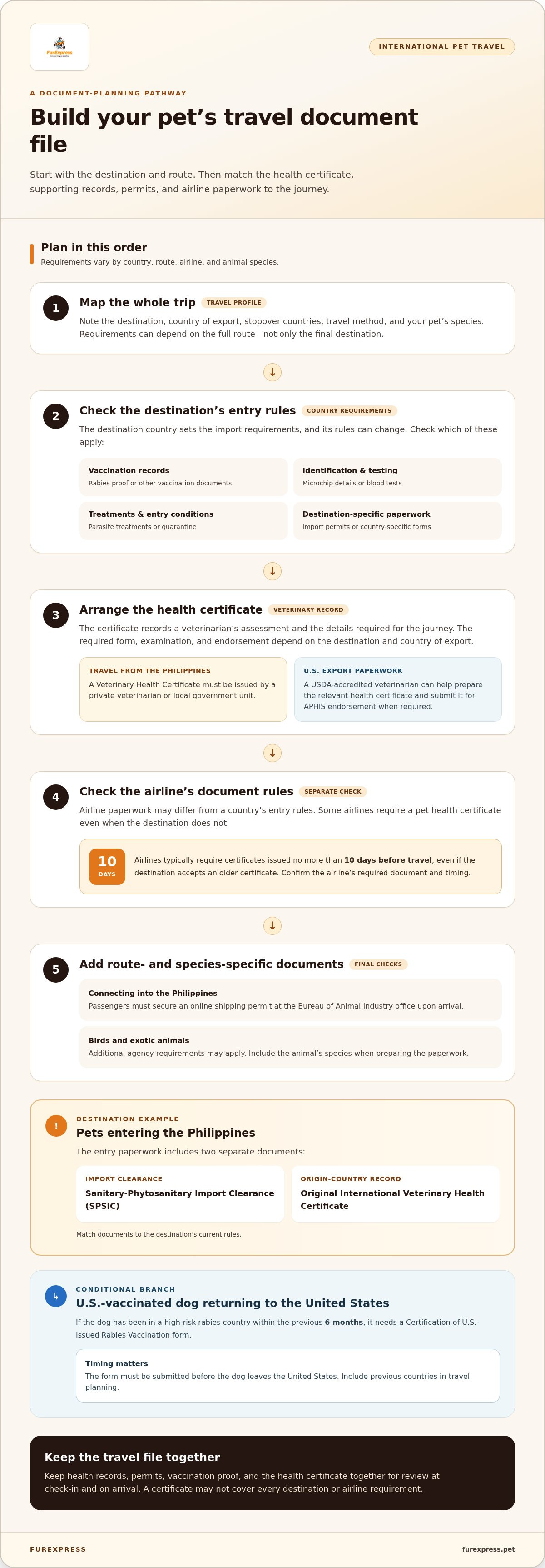
Beyond a health certificate, the destination country may require vaccination records, tests, treatments, or import permits. An airline may also require pet certification, even if the destination country does not.
U.S. Dog Return Requirements
Dogs returning to the United States may need extra rabies paperwork based on their vaccination history and recent travel. A U.S.-vaccinated dog that has been in a high-risk rabies country within the previous 6 months needs a Certification of U.S.-Issued Rabies Vaccination form. The form must be submitted before the dog leaves the United States, so owners should include previous countries in their travel planning.
Destination Country Import Rules
The destination country sets the animal import requirements, and these can change. Its rules may call for rabies vaccination proof, microchip identification, blood tests, parasite treatments, other vaccinations, or quarantine. Some countries also require an import permit or country-specific export forms. For example, pets entering the Philippines need a Sanitary-Phytosanitary Import Clearance (SPSIC) and an original International Veterinary Health Certificate from the country of origin. Match each document to the destination’s current rules.
Additional Airline Health Documents
Airline paperwork can differ from the destination’s entry requirements. Some airlines require a pet health certificate even when the destination country doesn’t. Airlines typically require certificates issued no more than 10 days before travel, even if the destination accepts an older one. Confirm which document the airline needs and when it must be issued, because a certificate that meets entry rules may still fall outside the airline’s timing policy.
Consider the route, too. Passengers connecting into the Philippines must secure an online shipping permit at the Bureau of Animal Industry office upon arrival. Keep health records, permits, and vaccination proof together for review at check-in and on arrival. Pet birds and exotic animals may be subject to additional agency requirements, so include the animal’s species when preparing travel documents.
What Is an International Pet Health Certificate?
A health certificate records a veterinarian’s assessment and the details required for a pet’s journey. The required form, examination, and official endorsement depend on the destination and country of export.
USDA-Endorsed Health Certificates
For travel from the United States, a USDA-endorsed certificate is a veterinary health form reviewed and endorsed by the United States Department of Agriculture. Most countries require a federally accredited veterinarian to complete the United States Interstate and International Certificate for Health Examination for Small Animals, Form 7001, and have USDA endorse it. That endorsement supports the certificate’s acceptance for export.
As of April 29, 2020, pet health forms are endorsed electronically through the Veterinary Export Health Certification System (VEHCS). The accredited veterinarian submits the certificate for endorsement. Destination rules determine what health details, rabies records, or supporting documents the completed form must include.
Country-Specific Certificate Requirements
Some countries use their own veterinary forms or require a separate import permit alongside the health certificate. For pets traveling from the Philippines, a Veterinary Health Certificate must come from a private veterinarian or local government unit. For pets entering the Philippines, the import clearance and the original health certificate from the country of origin serve separate roles in the entry paperwork.
Canada has a separate process for dogs and cats. A Canadian veterinarian completes the Canadian International Health Certificate, which an official government veterinarian then endorses. This distinction matters because a veterinary signature alone may not satisfy the destination’s documentation process.
International Certificates for Dogs and Cats
An international health certificate documents a pet’s health and any vaccinations or identification required for its route. The destination’s forms and rules determine what the veterinarian records, including rabies vaccination details where required. Keep the certificate consistent with your pet’s identification and supporting records.
Some exotic pets need different paperwork. A Canadian resident taking a qualifying CITES-listed pet abroad temporarily and frequently for personal purposes may apply for a CITES Certificate of Ownership. That certificate is valid for 3 years. For help coordinating travel arrangements alongside paperwork, see international pet travel support.
USDA-accredited veterinarians
A USDA-accredited veterinarian helps prepare animal health documents for travel from the United States. This matters because the destination may require both veterinary completion and government endorsement before export.
Certificate Completion and Endorsement
The veterinarian checks the destination’s requirements and completes the relevant health certificate based on the pet’s examination and records. If the certificate requires USDA endorsement, the accredited veterinarian submits it to the Animal and Plant Health Inspection Service (APHIS) on the owner’s behalf. Provide accurate details about the pet, destination, stopover countries, departure date, and travel method.
These details help match the certificate to the full route, not just the final destination. If a dog needs a Certification of U.S.-Issued Rabies Vaccination, the veterinarian must submit it before the dog leaves the United States. It cannot be issued retroactively. If you are arranging a return trip, include your dog’s recent travel history when discussing the paperwork.
Veterinary Preparation and Relocation Care
An accredited veterinarian can identify destination-required vaccinations, tests, and treatments, then explain how they relate to your pet’s records. Requirements depend on the destination country and the animal’s circumstances. Rabies vaccination timing and test results can affect the travel schedule, so discuss them before setting a departure date.
Veterinary preparation includes assessing the animal and recording relevant health information for the certificate. Medical care and travel paperwork are related but serve different purposes: the veterinarian addresses the pet’s health, while the certificate documents information required for travel. Bring vaccination records and test results to the appointment. For pets leaving the Philippines, a private veterinarian or local government unit issues the Veterinary Health Certificate.
Share the full itinerary, including stopovers, and explain whether your pet will travel alone, as cargo, or in the cabin. For travel paperwork involving the United States, USDA accreditation matters because the veterinarian submits eligible certificates for APHIS endorsement. Veterinarians outside the United States follow the applicable process for their country. Clear records and route details help prevent mismatched forms or missing supporting documents.
Advance preparation for international pet travel
Start with the destination, route, and departure date. These details shape the official entry requirements, veterinary schedule, and paperwork your pet will need.
For travel from the United States, contact a USDA-accredited veterinarian as soon as your plans take shape. Share your pet’s species, destination, stopover countries, departure date, and travel method. The veterinarian uses these details to identify required tests, vaccinations, treatments, and certificate steps. Explain whether your pet will travel alone, as cargo, or in the cabin.
For pets leaving the Philippines, timing matters. The pet must be at least 4 months old, and rabies vaccination must be given no earlier than 91 days after birth. For shipment, that vaccination must be given no more than 1 year and no less than 30 days before travel. These requirements affect when a young pet can leave and when its vaccination record will fit the travel schedule.
Check microchip timing alongside rabies vaccination. ISO-compliant microchips use standards 11784 and 11785. The microchip should be implanted before the required rabies booster, since identification needs to match the vaccination record. EU transponders do not read non-ISO microchips, which can affect pets traveling to the EU.
A regular veterinary appointment to prepare a pet for travel is typically within 10 days of departure. That short window makes earlier planning important: identify tests and treatments first, then schedule the examination and certificate around the route. Owners should keep vaccination records, test results, and microchip details together for the appointment and travel checks.
For help organizing Philippine travel paperwork and arrangements, plan your pet’s international travel with support suited to the route.
FurExpress: Domestic In-Cabin Pet Travel
FurExpress helps pet owners arrange domestic in-cabin pet travel and international journeys. Once your veterinarian has prepared the health documents, FurExpress can assist with the travel arrangements that fit your pet’s route and mode of travel.
For international trips, options include in-cabin travel, pet cargo transport, and pet excess baggage assistance. The right arrangement depends on the itinerary and how your pet will travel. For domestic travel, in-cabin assistance may suit owners planning to keep their pet with them during the flight.
FurExpress supports transport planning, while veterinary examinations and medical care remain with your veterinarian. For help with your pet’s travel arrangements, contact FurExpress about pet travel.
Set Your Pet’s Travel Plan in Motion
Give your pet’s journey a clear starting point: settle the route and travel arrangement, then coordinate the remaining preparations around them. This helps you plan veterinary appointments, airline arrangements, and the practical details your pet will need on travel day.
Preparing pet health documents for international travel is one part of a larger plan. Your pet’s travel method and itinerary shape the arrangements, while your veterinarian handles health assessments and medical records. Keeping those responsibilities clear makes the next steps easier to organize.
FurExpress can help with pet travel arrangements from the Philippines. If you’re ready to plan your pet’s journey, explore pet travel support. With a thoughtful plan and the right people handling each part, you can focus on preparing your pet for the journey ahead.
Frequently Asked Questions
Do I need a transit certificate if my pet connects through another country?
There isn’t one transit certificate for every route. The transit country’s animal rules and your airline’s paperwork requirements determine what your pet needs for a connection. Give your veterinarian the full itinerary, including stopover countries, rather than only the final destination. This helps identify route-specific requirements and keeps documents aligned with each stage of travel.
For How Long Is It Valid?
The international pet health certificate described in this guide is valid for a maximum of 10 days from its issue date. Airline timing rules may also affect when the examination and certificate should be arranged. For example, airlines typically require certificates issued no more than 10 days before travel, even if the destination accepts an older document. Match the certificate date to your flight schedule.
How long does USDA endorsement take, and what can I do to ensure timely processing?
USDA endorsement timing depends on the submission and processing of the completed certificate, so allow time before departure. A USDA-accredited veterinarian submits eligible health certificates to APHIS on your behalf. Share the complete route, travel date, pet details, and supporting records early. Accurate, consistent paperwork gives the veterinarian the information needed to prepare a complete submission.
What pet health documents are required for international travel from the Philippines?
For an international trip from the Philippines, prepare a Veterinary Health Certificate issued by a private veterinarian or local government unit, as well as the Philippine export permit. The destination may also require rabies vaccination proof, microchip details, blood test results, parasite treatment records, or additional forms. Airline paperwork can differ from government entry documents, so organize records by destination, route, and carrier.
How do I get a veterinary health certificate for a pet traveling abroad from the Philippines?
Arrange an examination with a private veterinarian or local government unit in the Philippines and explain that your pet is traveling internationally. Bring the destination requirements, itinerary, and available vaccination and identification records. The veterinarian uses the pet’s health assessment and applicable travel requirements to prepare the Veterinary Health Certificate. Check that your pet’s identifying details match the supporting records.
What are the Philippine Bureau of Animal Industry requirements for an international pet export permit?
The Bureau of Animal Industry (BAI) handles Philippine animal travel permits, including export permits. The permit paperwork needs to correspond with the animal and planned export, while health documents and destination rules determine the supporting information for the journey. Keep the pet’s certificate, vaccination records, identification details, destination, and itinerary consistent across forms. FurExpress offers Philippine Export Permit Processing for pet owners arranging this paperwork.


