
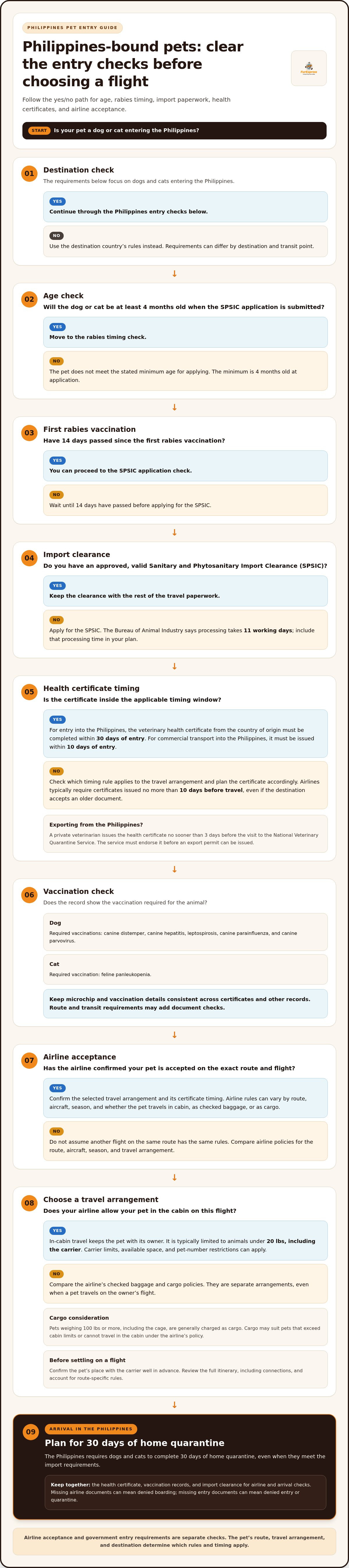
No. Airlines don’t all accept pets on international flights, and their rules can vary by airline, aircraft, route, season, and whether your pet travels in the cabin, as checked baggage, or as cargo. For entry into the Philippines, dogs and cats need a valid Sanitary and Phytosanitary Import Clearance (SPSIC); the Bureau of Animal Industry says processing an application takes 11 working days.
It’s natural to start by looking for a flight that can carry your pet. But airline acceptance is only one part of the plan. The destination’s import rules, export documents from the departure country, health paperwork, and any transit requirements all affect what you need and when.
This guide explains how international pet travel requirements affect your options, from in-cabin travel to checked baggage and cargo. You’ll learn what to consider when comparing airline policies, preparing health documents, and bringing a pet into the Philippines, so you can plan before booking.
Key Takeaways
- Compare cabin, checked baggage, and cargo options against your pet’s needs and the airline’s route-specific rules.
- Plan health certificates around both the destination’s entry rules and the airline’s timing requirements.
- Build your document plan around your departure country, destination, and any transit points.
- Choose the travel arrangement that fits your pet and itinerary, then organize the required paperwork before booking.
Veterinary health certificates
A veterinary health certificate records your pet’s condition and required vaccinations, but its format and timing depend on the destination. For Philippine exports, a private veterinarian issues the certificate no sooner than three days before your visit to the National Veterinary Quarantine Service. The service must endorse the certificate before an export permit can be issued.
Government and USDA Endorsement
Government endorsement is an official review that validates a veterinarian’s certificate for international travel. It matters because a destination may require endorsed paperwork, not just a veterinarian’s signature. For Philippine exports, submit the health certificate to the National Veterinary Quarantine Service for endorsement before an export permit can be issued.
For travel from the United States, a USDA-accredited veterinarian submits health certificates to the Animal and Plant Health Inspection Service (APHIS) for endorsement on the traveler’s behalf. This is separate from Philippine endorsement. Check that the issuing and endorsing authorities match the departure country and the destination’s document rules.
EU Pet Passports and Health Certificates
An EU pet passport is a travel record for eligible journeys within the European Union. For trips involving a non-EU country, such as travel from the Philippines, the destination’s entry rules determine which certificate and supporting documents apply. EU requirements are standardized and emphasize microchipping, rabies vaccination, and approved health certificates.
Keep microchip and vaccination details consistent across the passport or certificate and other records. A mismatch can make it difficult to show that the rabies vaccination belongs to the pet identified in the paperwork. Confirm which documents apply to the route, including any transit country with its own entry checks.
Airline Health Certificate Requirements
An airline health certificate requirement is the carrier’s rule for the certificate a pet must present to travel. Airlines typically require certificates issued no more than 10 days before travel, even if the destination accepts an older document. That timing can affect when you arrange the veterinarian visit and prepare the rest of the paperwork.
Compare the airline’s certificate window with the destination country’s entry rules before booking. For pets entering the Philippines, the veterinary health certificate from the country of origin must be completed within 30 days of entry. For commercial transport into the Philippines, it must be issued within 10 days of entry. The travel arrangement therefore affects the applicable deadline.
Do all airlines allow pets on international flights?
No. Airlines set their own pet acceptance rules, which can vary by route, aircraft, season, and travel arrangement. Airline acceptance does not replace the destination country’s entry requirements. A pet may meet the carrier’s conditions but still need separate import documents or quarantine arrangements on arrival.
For Philippine exports, the Bureau of Animal Industry requires export paperwork to meet the destination country’s rules. The National Veterinary Quarantine Service must endorse the health certificate before an export permit can be issued. A private veterinarian may issue the certificate no sooner than three days before the pet visits the service.
Importing a dog or cat into the Philippines requires an approved, valid Sanitary and Phytosanitary Import Clearance (SPSIC). According to the Bureau of Animal Industry, Philippines, processing an SPSIC application takes 11 working days. A dog or cat must be at least 4 months old when the application is submitted. After a first rabies vaccination, the importer must wait 14 days before applying for the SPSIC.
Rules also depend on the animal and destination. Dogs entering the Philippines need vaccinations against canine distemper, canine hepatitis, leptospirosis, canine parainfluenza, and canine parvovirus; cats need feline panleukopenia vaccination. The Philippines requires 30 days of home quarantine for dogs and cats, even when they meet import requirements. Other destinations may require different tests, waiting periods, or quarantine.
Missing an airline document can mean denied boarding; missing an entry document can mean denied entry or quarantine. Illness during travel is another concern, so discuss your pet’s fitness to fly with a veterinarian before departure. Keep the health certificate and vaccination records together for airline and arrival checks.
For help coordinating Philippine export paperwork with the trip plan, explore pet travel assistance.
Cabin, checked baggage, and cargo travel
Choosing a travel arrangement affects how your pet flies, not the destination’s entry rules. In the Philippines, pets arriving by air may enter as cabin pets, checked baggage, or air cargo at international airports in Manila or Cebu, subject to airline policies. Each option has different acceptance conditions, so match your pet’s size and itinerary to the carrier’s rules before booking.
In-cabin travel keeps a pet with its owner, but space and carrier limits apply. In-cabin pet travel is typically limited to animals under 20 lbs, including the carrier. The airline may also restrict pet numbers by aircraft, route, or season. Contact the carrier well in advance to reserve the pet’s place and confirm the specific flight accepts animals.
Checked baggage and cargo are separate arrangements, even when a pet travels on the owner’s flight. Pets weighing 100 lbs. or more, including their cage, are generally charged as cargo. Cargo transport may suit pets that exceed cabin limits or cannot travel in the cabin under the airline’s policy. Compare the full itinerary, including connections, before choosing.
Before travelling, align the chosen method with the required government paperwork. Entry rules may call for a health certificate, microchip, vaccination records, tests, or treatments. The certificate’s issue date and any required government endorsement matter alongside the airline’s document rules. Keep your pet’s identification and health records consistent so an inspection can match the paperwork to the animal.
Start your comparison with three details: your pet’s and carrier’s weight, airline acceptance for each flight, and the destination’s entry conditions. A small pet may fit an airline’s cabin limit, while a larger pet may need checked baggage or cargo. The travel method does not replace import clearance or other destination-specific requirements.
What documents are required for international pet travel from the Philippines?
The destination’s international pet travel requirements determine which documents your pet needs. The exact set depends on the destination country, your pet’s species, and the route. For a dog or cat leaving the Philippines, prepare Philippine export paperwork alongside the destination’s import documents. A transit country may also have rules if your itinerary requires customs clearance there.
For Philippine exports, the National Veterinary Quarantine Service must endorse the veterinary health certificate before an export permit can be issued. Keep the endorsed certificate and permit with your pet’s travel records. The destination may require a specific certificate format or supporting documents, so prepare paperwork for the country where your pet will arrive.
Common records to organize include:
- Veterinary health certificate: It records your pet’s health and relevant vaccinations. The required format and timing depend on the destination and travel arrangement.
- Philippine export permit: This follows endorsement of the health certificate by the National Veterinary Quarantine Service.
- Microchip details: International travel commonly requires a 15-digit ISO-compliant microchip. Ensure its details match the pet identified in the paperwork.
- Vaccination and test records: Rabies vaccination is central to many entry rules. The destination may also require other vaccinations, blood tests, or treatments.
- Destination import documents: Some countries require an import permit or government endorsement. Their entry rules determine the forms and supporting records.
Keep names, microchip details, vaccination dates, and certificate information consistent. Officials should be able to match the microchip number on the certificate with your pet’s identification. Store original documents and copies together for airline checks and arrival inspection. Review the international pet travel requirements for your route before assembling the final document set.
For Philippine export, keep the required documents aligned with your route; pet travel paperwork support can help coordinate the paperwork.
FurExpress: Domestic In-Cabin Pet Travel
FurExpress coordinates domestic and international in-cabin pet travel, international pet cargo transport, and excess baggage assistance, subject to airline acceptance and route, as stated in the written quotation. The suitable option depends on your route, airline rules, and how your pet can travel. In-cabin travel may suit a pet accepted in the cabin; cargo or excess baggage may suit other airline arrangements.
Turn to FurExpress when you’re comparing travel options or need help coordinating your pet’s air journey. You can focus on your pet while the travel arrangement is handled with care. The service is for air travel arrangements, not veterinary treatment, boarding, or land transport.
Visit FurExpress to discuss your pet’s travel arrangements.
Plan the next step with care
Before making travel arrangements, bring the key details into one plan: your pet’s destination, route, preferred travel arrangement, and document status. This makes it easier to match the international pet travel requirements with airline rules. It also keeps flight and paperwork decisions connected rather than treating them as separate tasks.
FurExpress can help you consider the appropriate air travel arrangement, whether your pet is travelling in the cabin or by cargo. The next step is to share your travel plans and discuss the support that fits your journey. You can contact FurExpress about pet travel when you’re ready.
With a clear plan, you can prepare for the journey one decision at a time while keeping your pet’s needs at the centre.
Frequently Asked Questions
How Far in Advance Should I Plan My Pet's Trip?
Start planning as soon as you know the destination and likely route. For many international trips, allow 60-120 days because permits, tests, vaccinations, and airline arrangements follow different schedules. Strict destinations such as Japan or Australia can require 6 to 8 months of preparation. Build your timeline around the longest waiting period, such as a rabies titer process, rather than the flight date alone.
How far in advance should I start planning international pet travel?
Begin researching the destination’s official pet entry rules at least 6 months before travel. Then work backwards from the longest test, vaccination, or permit timeline. For travel to the European Union or the United Kingdom, preparation commonly starts 3 to 4 months ahead. These planning windows help you sequence health steps and airline arrangements before choosing a departure date.
Is cargo safe for international pet travel?
Cargo is an established way for pets to travel by air, but it isn’t automatically right for every animal or itinerary. Before choosing it, discuss your pet’s fitness to fly with a veterinarian and review the airline’s crate and handling rules. Consider the route, connections, and arrival process together. A direct itinerary may reduce handling changes, while a connection adds another transfer to plan.
What documents do I usually need?
Most trips require a veterinary health certificate, vaccination records, and the destination’s import documents. The exact combination depends on your pet, departure country, destination, and transit route. Keep a copy of the microchip record with the health documents and check that identifying details match. Store original paperwork and accessible copies together so you can present the right records at airline check-in or arrival inspection.
What vaccinations, microchips, and parasite treatments are required for international pet travel?
Requirements depend on the destination. Many countries require a microchip before rabies vaccination, and international travel commonly uses a 15-digit ISO-compliant chip. Parasite treatment may be among the health steps required for international pet travel, so check the applicable requirements. Destinations can also require other vaccines or blood tests. Keep dates and identification consistent across veterinary records and travel forms.
What are the pet import requirements for popular destinations such as the US, UK, EU, Australia, and Japan?
Rules differ by destination and origin. The CDC sets rabies-related requirements for dogs entering the United States, while APHIS can set separate requirements. The UK requires tapeworm treatment within a 1-5 day window before arrival. EU rules emphasize microchipping, rabies vaccination, and health certificates. Australia requires a rabies titer test at least 6 months ahead; Japan has a 180-day wait after a successful titer test.


