

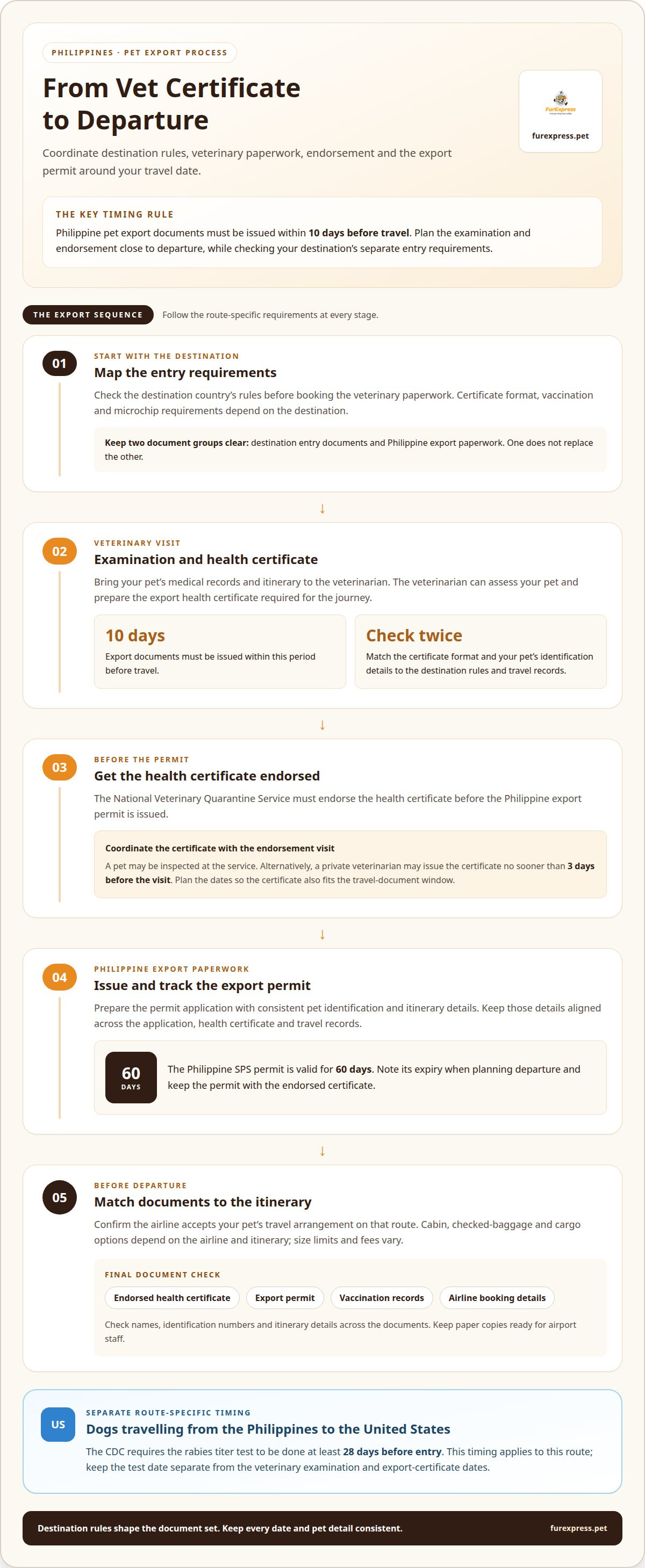
To prepare a pet for export from the Philippines, arrange the health certificate and required travel documents within 10 days before travel. The health certificate must be endorsed by the National Veterinary Quarantine Service before an export permit is issued. Good pet export assistance in the Philippines starts with matching each step to your destination’s rules.
It’s understandable to worry about missing a document or getting the timing wrong. Requirements vary by destination, so no single checklist covers every journey. Your pet’s records, vaccination dates, and travel plan need to align.
This guide explains how to prepare for the veterinary examination, health certificate, and BAI endorsement, and how to plan microchip registration and rabies vaccination timing. You’ll also learn which steps depend on your destination, so you can organize the paperwork and prepare your pet for the journey.
Key Takeaways
- Plan the veterinary examination and export health certificate around your destination’s rules, then arrange the required endorsement before the export permit is issued.
- Organize the Philippine export permit and BAI endorsement as linked paperwork steps, and keep the approved documents together for travel.
- Have your pet’s microchip details and vaccination records ready so identification and health documents can be matched accurately.
- For dogs entering the United States from the Philippines, the Centers for Disease Control and Prevention requires the rabies blood sample at least 30 days after vaccination, with the titer test completed at least 28 days before entry.
Export health certificates and veterinary examinations
Airline acceptance, fees, and pet size limits vary by carrier and route. Vaccination, microchip, and veterinary certificate requirements depend on the destination country’s rules.
Plan each document around your destination and departure date. The steps below explain how to coordinate veterinary checks, certificate endorsement, and route-specific timing.
-
Obtain Veterinary Health Certificates
Book a veterinary examination and bring your pet’s medical records and itinerary. The veterinarian can assess your pet and prepare the health certificate required for export. Check that the certificate follows the destination country’s required format. Before it is finalized, compare your pet’s identification details with the travel records.
-
Arrange Export Certificate Endorsement
Submit the health certificate for endorsement by the National Veterinary Quarantine Service before an export permit is issued. A pet may be inspected at the service, or a private veterinarian may issue the certificate no sooner than 3 days before the visit. Coordinate the examination date with the endorsement appointment to keep the certificate within its permitted timing.
- Keep the examination, endorsement, and departure dates together in one schedule. Philippine pet export documents must be issued within 10 days before travel. Avoid preparing them too early, and keep the planned itinerary consistent across the certificate and permit. If your travel date changes, review whether the document dates still fit the required window.
- For dogs entering the United States from the Philippines, the rabies titer test must be done at least 28 days before entry, according to the Centers for Disease Control and Prevention. This timing applies to that route. Include the test date in your schedule separately from the veterinary examination and export certificate dates.
- Before travel, assemble the endorsed health certificate, permit, vaccination records, and airline booking details. Check that names, identification numbers, and itinerary details match. Because destination rules determine which records are needed, use the relevant country’s requirements to prepare the final document set.
Philippine pet export permits and BAI endorsement
Pet export assistance in the Philippines involves coordinating departure paperwork with the destination’s entry conditions. Cabin, checked-baggage, and cargo travel are possible options, depending on the airline and route. Organize the permit process around the planned itinerary and the pet’s chosen travel arrangement.
- Start by listing the destination country’s import requirements. Separate entry documents from Philippine export paperwork, since one does not replace the other. Note the required certificate type, identification details, and any destination-specific approvals. This creates a document plan for your actual route, rather than a generic checklist.
- Prepare the Philippine export permit application with consistent pet and itinerary details. The National Veterinary Quarantine Service endorses the health certificate before the export permit is issued. Use the same animal identification and travel information on the application, certificate, and booking records. Inconsistencies can complicate document review.
- Record the permit’s validity period when planning the departure. The Philippine SPS permit is valid for Sixty (60) days. Set a reminder for its expiry and keep the permit accessible with the other travel papers. This helps you spot a schedule change that could affect the permit’s usable period.
- Choose a travel mode and itinerary that the airline accepts for your pet. Carrier rules determine whether cabin, checked-baggage, or cargo travel is available on the route. Ask about the applicable size limits and fees, then arrange the pet’s booking alongside the flight. Keep the airline’s confirmation with the permit documents.
- Prepare for possible document checks at departure and arrival. Missing or inconsistent paperwork can delay travel or prevent boarding. The destination may also require quarantine under its entry rules. Before leaving, compare your pet’s details across the permit, certificate, vaccination record, and booking confirmation. Keep paper copies ready for airport staff.
For imports of wild animals permitted in the Philippines, preapproval from the Department of Environment and Natural Resources is required. The usual approval time for a Philippine pet import permit is 1-2 days.
Microchipping and registration
- Check the destination country’s identification rules before arranging a microchip. Requirements differ between destinations, so match the chip standard to that country’s entry conditions. For dogs and cats entering the Philippines, the required microchip has 15 digits and complies with ISO 11784 or Annex A of 11785. Don’t assume a chip accepted for one route meets another country’s rules.
- Ask your veterinarian to scan your pet’s existing chip before travel preparations. Compare the scanned number with the vaccination records, health certificates, and permit paperwork. A mistyped digit can make records appear to belong to different pets. Write the number clearly in your travel file and use the same sequence on every document.
- If your pet needs a chip, ask your veterinarian to implant it and record its number. Keep the implantation record with your pet’s medical documents. Have the veterinarian scan the chip again and compare the result with the written record. This helps catch transcription errors before certificates are prepared.
- Keep the chip details and owner contact information together in your records. Registration procedures vary by destination, so follow the relevant country’s instructions. Carry the chip record with the vaccination documents and endorsed export certificate. This gives airline staff and officials a clear identification trail when they review the paperwork.
- For a pet entering the Philippines, identification has a clear consequence. Effective June 01, 2018, dogs and cats imported without the required identification are refused entry and returned to their origin at the importer’s expense. Treat the chip number as a core travel detail. Confirm it matches each document before departure, especially after any paperwork is updated.
- Before leaving for the airport, compare the scanned chip number with every document. Check your pet’s name and owner details, too. Keep a copy of the microchip record accessible with the travel papers. For an export from the Philippines, follow the destination country’s identification rules rather than assuming Philippine import requirements apply.
Minimum pet age and rabies vaccination timing
Start once you know the destination and route. Rabies vaccination, testing, and certificate timing can affect your departure date.
- Confirm the destination’s minimum age and rabies rules first. For puppies and kittens exported from the Philippines, the stated age range is 3 1/2-4 months. A destination may set a different minimum, so use its rules when planning the date your pet can travel.
- Review your pet’s rabies record with your veterinarian. Pets exported from the Philippines must receive rabies vaccination at least 14 days before export, or follow the destination country’s regulations. Record the vaccination date clearly, since later test and document schedules may depend on it.
- For a dog entering the United States from the Philippines, check the age requirement early. The dog must be at least 6 months old. The Centers for Disease Control and Prevention also requires the rabies blood sample to be taken at least 30 days after vaccination.
- Build the United States timeline around both milestones. The blood sample cannot be collected before the required post-vaccination interval. The rabies titer test must also be done at least 28 days before entry, according to the Centers for Disease Control and Prevention. Keep those dates distinct when scheduling your veterinarian visit.
- Work backward from the planned departure and arrival dates. Include the vaccination date, any destination-required testing, veterinary examination, and export paperwork. Philippine export documents must be issued within 10 days before travel, so coordinate those final documents after accounting for longer vaccine or testing intervals.
- Keep a dated record of each vaccination, blood sample, and test result. Match the pet’s identification details across the veterinary records and travel paperwork. For help coordinating the export permit and rabies testing steps, explore FurExpress rabies titer testing assistance.
For puppies and kittens entering the Philippines, they must be four months old and fully vaccinated against rabies at least 30 days before entry. Dogs and cats entering the Philippines must be vaccinated against rabies between 30 days and 12 months before arrival.
Plan entry timing separately from export timing, and confirm that each requirement is met by the planned arrival date. Keep your pet’s age and vaccination record together so they can be checked against the entry windows.
FurExpress: International Pet Cargo Transport
FurExpress can assist with international pet cargo transport when your pet travels separately, as stated in the written quotation. Cargo arrangements are subject to airline acceptance and route.
Share your route and travel plan to explore whether this option fits your pet’s journey. FurExpress also assists with in-cabin and excess-baggage travel, subject to airline acceptance and route, as stated in the written quotation.
Contact FurExpress about international pet cargo transport when you’re ready to discuss your pet’s travel arrangements.
Plan the next step with confidence
Your next step is to turn your pet’s route into a practical travel plan. Decide whether your pet will travel with you in the cabin or separately, then align the arrangements with the destination’s entry rules. This keeps travel decisions connected to your pet’s needs and paperwork.
For pet export assistance in the Philippines, FurExpress offers domestic and international in-cabin pet travel, along with international pet cargo transport. The right option depends on your route and travel arrangement. FurExpress can help with the travel service that fits your plan.
When you’re ready to discuss the journey, contact FurExpress about your pet’s travel plan. A clear plan is a reassuring place to begin, and your pet’s next journey can take shape one careful step at a time.
Frequently Asked Questions
How do I get a Philippine Bureau of Animal Industry export permit for a pet?
Prepare the export health certificate and submit it for endorsement through the National Veterinary Quarantine Service, part of the Philippine Bureau of Animal Industry. The endorsement must be completed before the export permit is issued. Coordinate your veterinary appointment and paperwork with your destination’s entry rules. Keep your pet’s identification and travel details consistent across documents so the permit process uses accurate information.
Which pet relocation companies in the Philippines assist with international exports, and how do they compare?
Compare providers by the travel arrangements and paperwork they handle, rather than assuming their services are identical. FurExpress offers international pet cargo transport, in-cabin travel, excess-baggage assistance, and Philippine export permit processing, as stated in the written quotation. In-cabin and excess-baggage travel are subject to airline acceptance and route. Review which arrangement fits your pet’s itinerary, then visit FurExpress pet travel assistance to learn about its support.


