
The simpler-looking option isn’t always the more flexible one. With pet excess baggage vs cargo, excess baggage is linked to your passenger itinerary, while manifest cargo travels under a separate shipment booking and air waybill. Cargo may travel before or after you, or on a different route.
It’s understandable to prefer one booking and one journey when travelling with your pet. Excess baggage may suit straightforward domestic trips or some international routes, but pet spaces depend on the airline, route, and aircraft. The right arrangement depends on your itinerary and your pet’s needs.
This guide explains how the two options differ in booking, crate preparation, paperwork, and timing for travel to, from, or within the Philippines. A side-by-side comparison and practical decision guide will help you assess when excess baggage may work and when a separate cargo booking offers more flexibility.
Key Takeaways
- Choose between a pet traveling on your passenger itinerary and a separately booked cargo shipment based on how closely your pet needs to travel with you.
- Plan crate preparation, route-specific paperwork, and booking early, since pet space may be limited and requirements vary by journey.
- Use the same core planning checklist for either option, then account for the airline and destination’s specific rules.
- Consider excess baggage for straightforward domestic trips or suitable international routes; compare the route and booking arrangements before deciding.
Passenger booking versus separate cargo booking
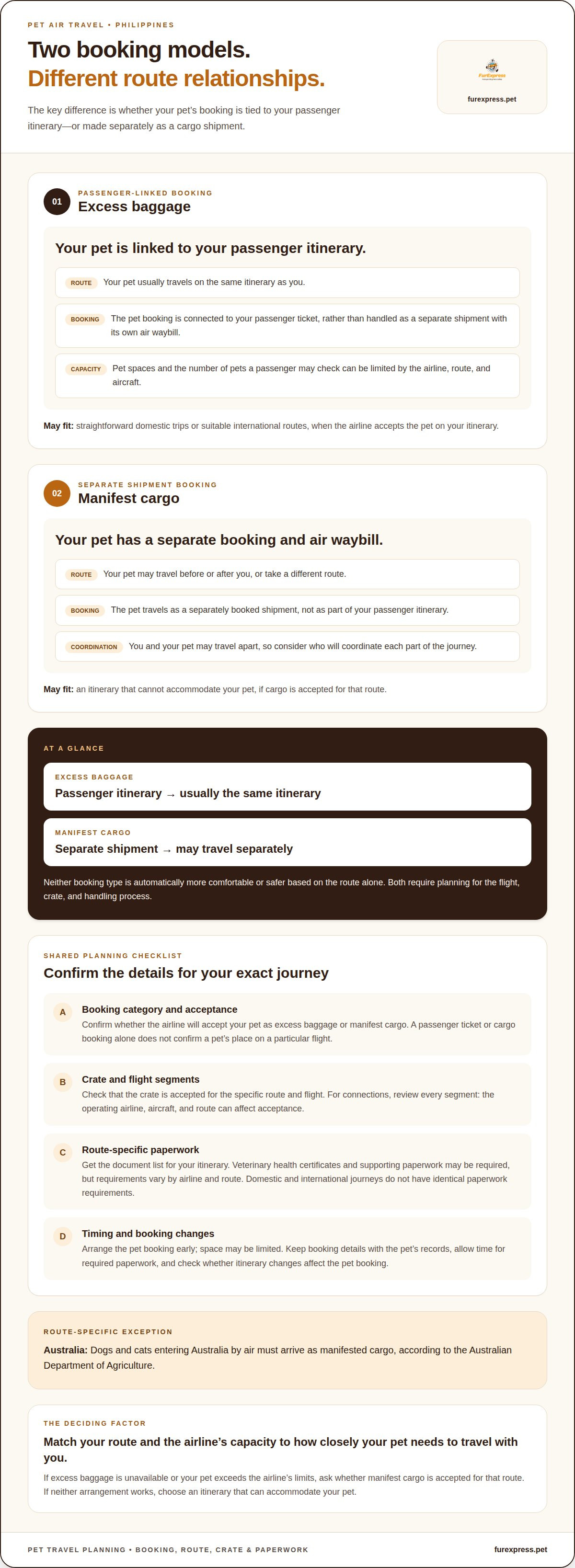
The key difference is the booking: excess baggage is linked to your passenger itinerary, while manifest cargo has its own shipment booking. This affects how your pet’s route and travel arrangements connect with yours.
Passenger-Linked Excess Baggage
With excess baggage, your pet’s booking is connected to your passenger ticket, and your pet usually travels on the same itinerary. The airline handles the pet as part of that journey, rather than as a separate shipment with its own air waybill. For example, a pet travelling with you on the same flight is linked to your booking.
Airlines may limit the number of pets each passenger can check, and those limits vary by route and aircraft. This option depends on both your ticket and the operating airline’s pet capacity.
Manifest cargo uses a separate booking and an air waybill. Your pet can travel before or after you, or take a different route, which may help when your itinerary cannot accommodate the animal. Dogs and cats entering Australia by air must arrive as manifested cargo, according to the Australian Department of Agriculture.
Travel Risks and Welfare Differences
Neither booking type is automatically more comfortable or safer based on the route alone. Both require planning for the flight, crate, and handling process. Excess baggage links your pet’s travel to your itinerary; cargo allows a separate route or departure, so you and your pet may travel apart.
That separation is the practical welfare consideration: think about how your pet’s journey fits with yours and who will coordinate each part. The booking category alone does not determine the level of care during transit.
In the Philippines, pet acceptance depends on the airline, route, aircraft, and booking category. There is no single airline rule for every domestic or international journey. Excess baggage and cargo are separate arrangements, each requiring acceptance.
If your pet exceeds the airline’s baggage limits or the airline does not accept pets as excess baggage, that option is unavailable. A separate manifest-cargo booking may be an alternative if accepted for the route. Otherwise, choose an itinerary that can accommodate your pet.
| Option | Booking | Route relationship |
|---|---|---|
| Excess baggage | Linked to passenger itinerary | Usually same itinerary |
| Manifest cargo | Separate shipment and air waybill | May travel separately |
Choose by matching your route and the airline’s capacity to whether your pet needs to travel with you.
Preparing crates, paperwork, and timing
For a domestic flight within the Philippines, documents and permits depend on the route and airline. Pet air travel generally requires an airline-approved crate, advance booking, and supporting paperwork specific to the route. Airlines may require a recent veterinary health certificate, but requirements vary.
Start with the airline’s pet booking process before choosing or preparing a crate. Confirm that the crate is accepted for your flight and meets the airline’s requirements. Then give your pet time to get used to it at home. For example, place the crate in a quiet area and let your pet explore it before travel day. Don’t assume a crate used for another airline or route will be accepted.
Prepare the paperwork for your specific itinerary. Keep the passenger booking or cargo shipment details with your pet’s records so names and travel dates are easy to compare. Get the airline’s document list for the route, then arrange any required veterinary certificate and supporting documents. A domestic flight within the Philippines is not an international entry or export journey; the paperwork depends on the actual trip.
Timing matters because airlines usually require advance booking, and pet spaces may be limited. Arrange your pet’s booking early in the planning process rather than assuming a confirmed passenger ticket also secures a place for your pet. For a connection, review every flight segment: the operating airline, aircraft, and route can affect acceptance. Changes to your itinerary may also require changes to your pet’s booking.
- Match the crate to the airline’s rules for the exact route.
- Keep the pet booking and travel documents together.
- Allow time for veterinary paperwork and airline arrangements before departure.
- Review each flight segment when the itinerary includes a connection.
Shared requirements for pet air travel
Excess baggage and manifest cargo both require planning around your pet, route, and airline. A passenger ticket or cargo booking alone does not confirm that a pet can travel on a particular flight. Pet spaces may be limited, so treat your pet’s booking as a separate planning step.
For a pet travelling in the aircraft hold, start with an airline-approved crate. Confirm acceptance for the specific flight before preparing it, since the operating airline and aircraft can affect the arrangement. If the journey includes a connection, consider each flight segment, not just the first departure.
Paperwork depends on the route. Airlines and destination countries often require a recent veterinary health certificate and supporting documents, but requirements vary. A domestic Philippine flight and an international journey do not have identical paperwork requirements. Make a route-specific document list, then match each item to your pet and itinerary.
What are the airline rules for pet carriers, weight limits, and breed restrictions in the Philippines? There is no universal carrier, weight, or breed allowance for every airline and route. When deciding between pet excess baggage vs cargo, use the rules for the operating airline, route, and aircraft.
- Confirm the booking category. Identify whether the airline will handle the pet as excess baggage or manifest cargo.
- Check the full itinerary. List each operating airline and flight segment, including connections.
- Match the crate to the flight. Confirm that the carrier is accepted for that route and aircraft.
- Build a document checklist. Separate domestic travel paperwork from requirements for each international destination.
- Arrange veterinary documents. If the route requires a health certificate, plan the veterinary visit around its applicable timing.
For example, on a trip with a connection, assess each operating flight segment individually. A direct international flight also requires destination-specific paperwork, not assumptions based on a previous domestic journey. This preparation helps distinguish airline acceptance from destination entry requirements.
When excess baggage may be suitable
Excess baggage may suit a straightforward domestic trip when the airline accepts pets on the route and your pet’s booking fits your passenger itinerary. It may also suit some international routes. For a Philippine departure, consider the complete itinerary, including connecting flights, rather than judging suitability by the first flight alone.
Start by comparing your planned journey with your pet’s travel arrangements. A direct flight with a confirmed pet booking may be simpler to coordinate than an itinerary involving several operating airlines. A connection can add separate acceptance requirements, so assess each segment before deciding. Your passenger ticket alone does not confirm that your pet can travel.
- Excess baggage may fit when your pet can follow your itinerary and the airline accepts the pet on every flight segment.
- Consider separate cargo booking when your pet needs to travel on a different schedule or route.
- Check destination rules before booking. Dogs and cats entering Australia by air must arrive as manifested cargo.
- Reassess after itinerary changes because a new airline or aircraft can affect pet acceptance.
For example, a direct domestic flight may suit excess baggage if the airline accepts your pet and the booking aligns with your travel plans. An international route requires another layer of planning: destination entry rules may specify the arrival method. Australia is one example, where dogs and cats must travel by air as manifested cargo.
Use a simple decision sequence. First, identify the destination and its required arrival arrangement. Next, compare your pet’s route with your passenger itinerary. Then check each operating airline and flight segment for pet acceptance. If the arrangements align, excess baggage may be suitable. If the destination or itinerary calls for separate handling, consider cargo instead. Choose based on the actual route, not convenience alone.
FurExpress: Domestic In-Cabin Pet Travel
FurExpress helps pet owners plan travel arrangements around their route and pet. For domestic trips, its Domestic Pet Travel service can include in-cabin travel, subject to airline acceptance and route. FurExpress also coordinates pet travel as excess baggage and international pet cargo, subject to airline acceptance and route. Services and inclusions are as stated in the written quotation.
The distinction matters: excess baggage connects your pet’s booking to your passenger itinerary, while cargo is booked as a separate shipment. For a Philippine journey, FurExpress can coordinate the travel option and related assistance stated in the written quotation. The right fit depends on the route, airline acceptance, and whether your pet can travel in the cabin.
Visit FurExpress pet travel assistance to discuss your pet’s travel plans.
Choose the travel plan that fits your pet
Your next step is to match your pet’s travel arrangement to the journey you’re planning. The pet excess baggage vs cargo decision is part of that plan, alongside whether your pet can travel in the cabin and what the route requires. Share your itinerary and pet’s details with FurExpress to get a written quotation for the relevant arrangements.
FurExpress supports domestic and international in-cabin pet travel, as well as international pet cargo transport. If you’re preparing a trip and would like help considering the available option for your pet’s journey, contact FurExpress about your pet’s travel.
With a suitable plan in place, you can focus on preparing for the journey together.
Frequently Asked Questions
What is the difference between transporting a pet as excess baggage and as cargo?
Excess baggage connects your pet’s booking to your passenger journey; cargo is arranged as a separate shipment. This affects whether your pet travels with you or can take a different itinerary. For example, if you need to travel separately from your pet, cargo may suit that arrangement better. The right choice depends on the route, airline acceptance, and your pet’s travel plan.
How do you book a pet as excess baggage or air cargo with a Philippine airline?
First, identify the airline operating each flight and whether it accepts pets under your intended booking type. For excess baggage, arrange your pet’s booking alongside your passenger itinerary. For cargo, arrange a separate shipment booking and air waybill. Then organize the route-specific crate and paperwork. If your itinerary includes partner airlines or connections, account for every flight segment: acceptance on one flight does not confirm acceptance on another.
How early should pets arrive for check-in or cargo acceptance, and what are the airport procedures?
There is no single arrival time that applies to every airline, airport, and booking type. The airline’s acceptance window depends on the route and whether your pet travels as excess baggage or cargo. For passenger travel, follow the airline’s pet check-in instructions and present the required documents. For cargo, follow the shipment’s acceptance instructions and submit the required paperwork with your pet. Keep records and booking details together.


