
Air is mostly nitrogen: 78% by volume, alongside 21% oxygen, 0.9% argon, and 0.03% carbon dioxide. In aviation, it’s the atmosphere aircraft travel through, so pet air cargo in the Philippines refers to pets transported by aircraft as cargo rather than traveling in the cabin with their owner.
Aviation terms can feel technical when you’re trying to understand how your pet will travel. Knowing what “air” means in this context helps distinguish general aviation language from the practical details of pet cargo transport.
This guide explains what “air” means in aviation and how the term applies to pet air cargo in the Philippines. It also clarifies common cargo terminology to help you understand the different ways pets may travel by air.
Key Takeaways
- Learn how airline cargo policies shape the available route and transport arrangement for a pet.
- Understand how import and export steps differ depending on where your pet is traveling.
- See how permits and veterinary documents fit into preparing a pet for air transport.
- Follow the main booking-to-pickup stages and identify when in-cabin travel may suit your plans better.
Which airlines transport pets as air cargo to, from, or within the Philippines?
Live-animal cargo acceptance means an airline agrees to transport a pet in its cargo service. Philippine Airlines and Cebu Pacific operate flights serving the Philippines, but their passenger routes alone don’t establish that they accept pets as cargo. Review the Philippine Airlines and Cebu Pacific information for the specific route, then confirm live-animal cargo acceptance with the operating carrier.
A cargo booking is separate from a passenger ticket. An airline may allow a pet under one travel arrangement but not another. Ask whether the airline accepts live animals on every flight segment, including connections, and which cargo office handles the booking.
For a Philippine itinerary, identify the operating airline rather than relying only on the carrier named on your booking. Codeshares and connections may involve different airlines, with different acceptance rules, crate instructions, and handover arrangements. Confirm the details for the pet’s entire route.
Check these details with the airline’s cargo team:
- Route acceptance: Ask whether live pets travel as cargo between the exact origin and destination.
- Flight segments: Identify the operating carrier for every connection and transfer.
- Booking process: Confirm how the cargo request is submitted and where the pet is handed over.
- Carrier requirements: Ask about crate specifications and documents for that route.
Air pressure is the force exerted by the atmosphere. At sea level, it is about 14.7 pounds per square inch, according to the National Oceanic and Atmospheric Administration. That atmospheric figure doesn’t determine an airline’s pet-cargo acceptance.
For pet air cargo in the Philippines, assess each route separately. A carrier’s service on one route doesn’t mean it is available on another. Confirm acceptance with the operating carrier for the full itinerary before arranging the shipment.
Half of Earth’s atmospheric mass is within four miles of its surface. This describes the atmosphere, not an airline’s decision about accepting a pet as cargo on a specific route. Keep the figure separate from your cargo inquiry: ask the operating carrier about acceptance for the exact route and every flight segment. An atmospheric measure does not confirm transport.
What are the Philippines import and export requirements for pets traveling by air cargo?
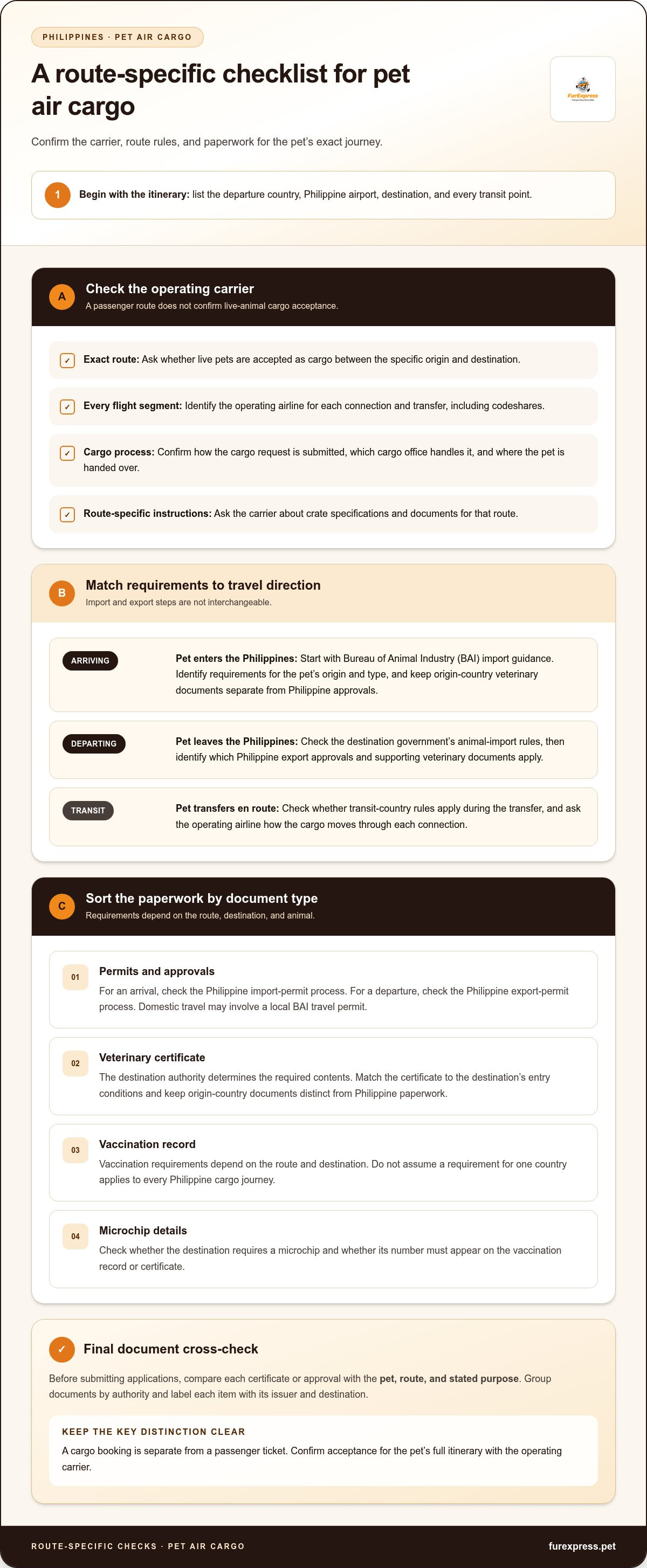
Import requirements apply when a pet enters a country; export requirements apply when it leaves. For Philippine routes, the country of origin, destination, and transit points determine which authorities’ rules apply.
For an arrival in the Philippines, start with the Bureau of Animal Industry (BAI) import guidance. Identify the requirements for the pet’s origin and type, then follow the current BAI application instructions for any Philippine import approval. Check the official Bureau of Animal Industry information for the current process and documents. Keep the origin country’s veterinary documents separate from Philippine approvals.
For a departure from the Philippines, consult the destination country’s official animal-import rules to identify its entry conditions. Then determine which Philippine export approvals and supporting veterinary documents apply. Requirements may vary by origin and animal, so follow guidance for the specific route rather than relying on a generic international checklist.
Organize the route details before reviewing applications:
- Write down the itinerary: Include the departure country, Philippine airport, destination, and every transit point.
- Check arrival rules: Use the destination government’s animal-import authority for a departure, or BAI guidance for an arrival.
- Identify Philippine paperwork: Match the direction of travel to BAI’s import or export process.
- Compare the documents: Make sure each certificate or approval applies to the pet, route, and purpose stated.
A transit country may affect planning if its rules apply during the pet’s transfer. Ask the operating airline how the cargo will move through each connection, then compare the itinerary with the relevant government requirements.
Keep documents grouped by authority and label each item with its issuer and destination. This helps distinguish Philippine approvals from another country’s entry documents and keeps the paperwork aligned with the actual route.
Which permits, veterinary certificates, vaccinations, and microchips are required for pet air cargo in the Philippines?
A permit is an official document tied to a specific animal movement. For an arrival, review the Philippine import permit process; for a departure, review the Philippine export permit process. Domestic travel may involve a local BAI travel permit. The Bureau of Animal Industry’s official information is the place to identify the applicable process and current application instructions.
A veterinary certificate records an animal’s health details for travel. Its required contents depend on the destination authority’s rules, so international travel calls for destination-specific guidance. For a pet entering the Philippines, distinguish origin-country veterinary documents from Philippine import paperwork. For a pet leaving, match the certificate to the destination’s entry conditions and the Philippine export process.
A vaccination record documents the vaccines given to a pet. Requirements depend on the route and destination, so don’t assume a rule for one country applies to every Philippine cargo journey. A microchip is an implanted identifier. Check whether the destination requires one and whether its number must appear on the vaccination record or certificate.
Sort documents by journey type before submitting applications:
- International arrival: Identify Philippine import-permit steps and the origin documents required for entry.
- International departure: Match Philippine export paperwork with the destination’s animal-entry requirements.
- Domestic air cargo: Identify whether a local BAI travel permit applies to the route.
- All routes: Compare pet identification details across permits, certificates, and vaccination records.
There is no universal vaccination or microchip checklist for every destination. For international travel, follow the destination government’s animal-import instructions and the BAI’s current process for Philippine approvals. Compare those requirements with the airline’s cargo document instructions. Leave veterinary decisions to your veterinarian, and ensure the pet’s identifying details match across all documents.
How to Book Pet Air Cargo in the Philippines
A cargo booking request asks an airline to accept a pet on a specific route. Start with the departure and arrival airports, travel date, pet’s species, and crate measurements. Include the pet’s weight with the crate, since the airline uses shipment details to assess transport arrangements. For a connection, list each flight segment and operating carrier.
Route assessment means matching the itinerary with airline acceptance and required paperwork. Compare direct and connecting options, then ask the operating airline about live-animal acceptance, crate specifications, booking procedures, and cargo-terminal arrangements. Details vary by carrier and route. A passenger reservation does not confirm a separate cargo booking.
- Prepare the journey details: Record the route, preferred date, pet information, crate dimensions, and combined weight.
- Request cargo space: Submit those details through the airline’s cargo booking channel. Ask how the carrier handles transfers and document review.
- Complete preparations: Follow the accepted route’s crate instructions and organize the permits and veterinary documents required for that journey.
- Confirm handover and collection: Get the cargo acceptance location, drop-off instructions, and arrival release or pickup procedure in writing.
An air waybill is a transport document that records a cargo shipment. Ask when the airline issues it and which shipment details it contains. Keep its reference with the pet’s paperwork and itinerary to connect the booking with the cargo-handling process.
Handover means presenting the pet and shipment for airline acceptance. Follow the assigned cargo-terminal instructions and bring the documents required for the route. At arrival, release means completing the carrier’s collection process. Before departure, confirm the receiving terminal, collection requirements, and any transfer arrangements. These details are especially important if someone other than the owner will collect the pet.
For domestic shipments departing Manila, Cebu, or Davao, the origin airport shapes the booking and handover plan. For international travel, align the cargo itinerary with the destination’s entry requirements. A clear sequence, booking, paperwork, acceptance, and pickup, helps you manage each stage without confusing airline procedures with government approvals.
FurExpress: Domestic In-Cabin Pet Travel
FurExpress can help you compare cargo travel with an in-cabin option for a domestic journey. Its Domestic In-Cabin Pet Travel service supports owners whose plans and airline arrangements allow their pet to travel in the cabin, subject to airline acceptance and route. For journeys where cargo is suitable, FurExpress also offers International Pet Cargo Transport, as stated in the written quotation.
The right option depends on your route and the airline’s rules. Share your travel plan when seeking support, especially if you’re comparing cabin travel with cargo or arranging an international shipment. FurExpress can assist with the travel arrangements, as stated in the written quotation; veterinary care remains with your veterinarian.
For guidance on your pet’s travel arrangements, contact FurExpress through its pet travel website.
Choose the travel arrangement that fits your next step
Your next decision is how your pet should travel in relation to your own plans. Consider whether you’ll be on the same flight, whether an in-cabin arrangement suits the route, or whether cargo better fits the journey. For pet air cargo in the Philippines, a clear route and travel preference are a practical starting point for arranging support.
FurExpress offers Domestic In-Cabin Pet Travel, International In-Cabin Pet Travel, and International Pet Cargo Transport, as stated in the written quotation. Discuss which arrangement best matches your journey rather than treating every pet trip as the same process.
Share your route and preferred travel arrangement with FurExpress to discuss pet travel support. With the right next step in view, you can plan your pet’s journey with greater clarity and care.
Frequently Asked Questions
How does pet air cargo compare with bringing a pet in the cabin or as checked baggage in the Philippines?
Air cargo means a pet travels as cargo rather than in the cabin, and it requires a separate booking from a passenger ticket. In-cabin travel may better suit some plans, subject to airline acceptance and route. This article does not compare cargo with checked baggage.
Which Philippine airports handle live animal air cargo, and where can pets be collected?
The article does not identify specific airports. Before departure, confirm the receiving cargo terminal and collection procedure with the airline.


