
Flying a pet to the Philippines in the cabin depends on two things: meeting the country’s import requirements and securing airline approval for your pet and carrier. Dogs and cats need an approved, valid Sanitary and Phytosanitary Import Clearance (SPSIC), which is valid for 60 days. According to the Bureau of Animal Industry, dogs and cats entering the Philippines will require a rabies titer test after January 1, 2027.
It’s understandable to want the details settled before booking, especially when vaccination dates, paperwork, and airline rules all affect the trip. This guide explains entry requirements, rabies vaccination timing, dog and cat rules, and advance pet booking. It also covers how airline policies shape in-cabin eligibility, so you can plan documents and flight arrangements in a clear order.
Key Takeaways
- Map out the Philippine import paperwork early and keep your permit and health documents aligned.
- Plan rabies vaccination dates around both entry rules and the application timeline.
- Use your pet’s age, health status, and carrier setup to assess whether the trip can work.
- Arrange the airline booking separately from entry paperwork, since cabin acceptance depends on the carrier’s rules and available space.
What are the travel requirements for pets?
International in-cabin pet travel to the Philippines requires both entry documents and airline approval. For a smooth arrival, plan each requirement around your destination, origin, and flight route.
Carrier Dimensions and Construction
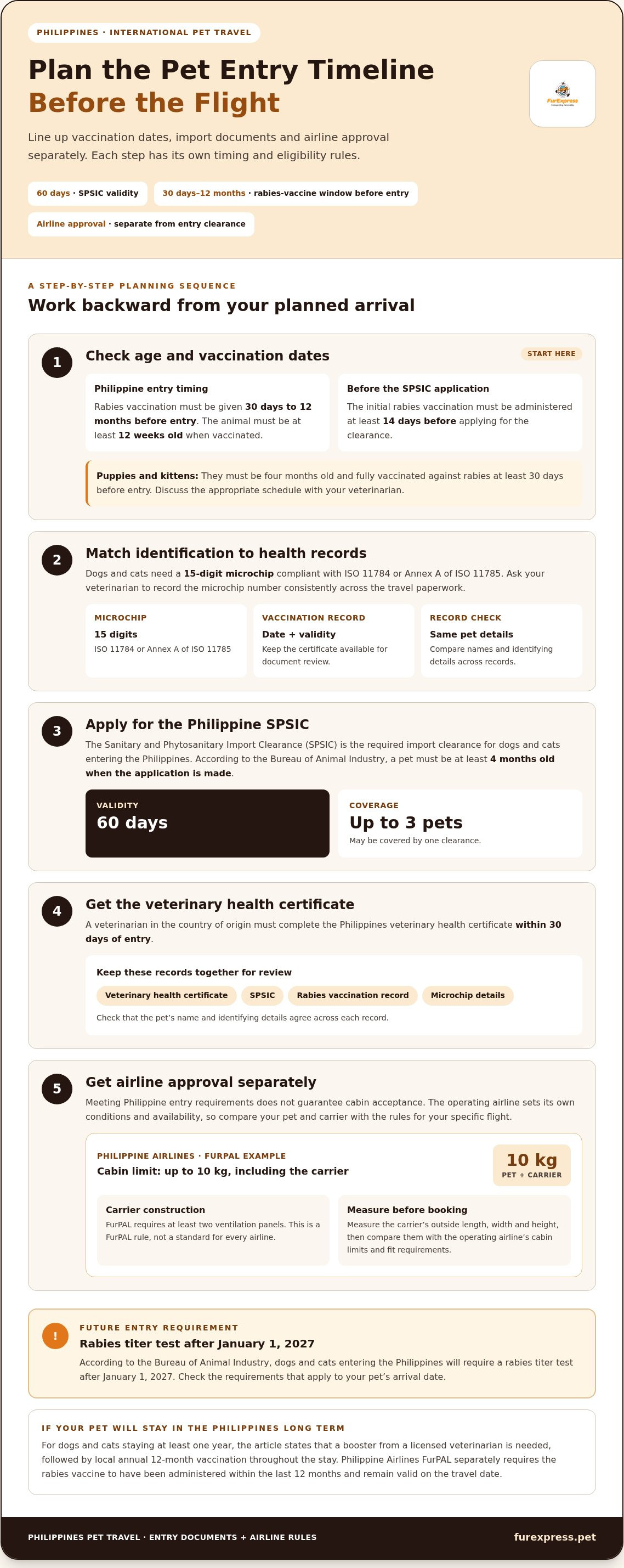
A pet carrier is the container an airline accepts for cabin travel. Philippine Airlines’ FurPAL requires at least two ventilation panels. This is a FurPAL rule, not a standard for every airline. Measure the carrier’s outside length, width, and height, then compare them with the operating airline’s cabin limits. Check how the carrier must close and fit on board. A carrier can meet ventilation requirements yet exceed the size limit for a particular flight.
Destination Import Requirements
Destination import requirements are the rules a country applies before allowing an animal across its border. International in-cabin pet travel to the Philippines requires an approved, valid Sanitary and Phytosanitary Import Clearance (SPSIC). The clearance is valid for 60 days and may cover up to three pets. Dogs and cats entering the Philippines will require a rabies titer test after January 1, 2027, according to the Bureau of Animal Industry. Check requirements for your pet’s origin and arrival date, including any transit country’s rules.
Vaccination and Identification
Vaccination and identification records document your pet’s health and link those details to its identity. Dogs and cats must receive rabies vaccination between 30 days and 12 months before entry. The initial vaccination must be given at least 14 days before the SPSIC application. The pet also needs a 15-digit microchip compliant with ISO 11784 or Annex A of ISO 11785. Ask your veterinarian to record the microchip number consistently across health and travel paperwork.
Veterinary and Travel Documents
Veterinary and travel documents are the records used to assess import eligibility and health status. A veterinarian in the country of origin must complete the Philippines veterinary health certificate within 30 days of entry. Keep the certificate, SPSIC, vaccination record, and microchip details together for airline review and inspection at the airport. Compare the pet’s name and identifying details across each record before departure, so differences can be addressed before travel.
Rabies vaccination timing
Rabies vaccination timing is the schedule that makes a dog’s or cat’s vaccine valid for Philippine entry and travel. The animal must be at least 12 weeks old when vaccinated. If your pet has previously been vaccinated against rabies, review its vaccination history and whether a booster may be needed before applying for the SPSIC. The initial vaccination must be administered at least 14 days before that application. Plan backward from the intended application date, then compare the vaccination record with the planned arrival date.
For Philippine entry, the rabies vaccination must fall between 30 days and 12 months before arrival. Philippine Airlines has a separate FurPAL condition: the vaccine must have been administered within the last 12 months and remain valid on the travel date. The Philippines recognizes a source-country vaccine with 3-year validity. However, dogs and cats staying in the country for at least one year need a booster from a licensed veterinarian, followed by the local annual 12-month vaccination throughout their stay.
Puppies and kittens must be four months old and fully vaccinated against rabies at least 30 days before entry. Their age and vaccination dates therefore affect the earliest eligible arrival date. Keep the vaccination certificate and planned flight details together. Check that the certificate identifies the animal clearly and records the vaccination date and validity. Your veterinarian can advise on the appropriate vaccination schedule and document the administered vaccine.
A rabies antibody titer test is a laboratory test that measures an animal’s response to rabies vaccination. Treat its result as a separate record from the vaccination certificate, and keep both available for travel-document review. Before arranging testing, confirm that the destination accepts the laboratory. The test, vaccine record, and microchip details should identify the same animal.
What are the requirements for Dogs & Cats?
Dogs and cats must meet Philippine entry rules and the operating airline’s conditions. A local transport permit may also apply to journeys within the Philippines.
The Philippine SPSIC application is the import-permit step for a dog or cat. According to the Bureau of Animal Industry, a dog or cat must be at least 4 months old when its Philippine SPSIC application is made.
A local transport permit is written authorization for animal transport within the Philippines. Dogs and cats must be at least 2 months old for the listed local permit requirements. Their vaccination must be given at least fourteen (14) days before travel and no more than one (1) year before travel. Public utilities need written permission from the Bureau of Animal Industry or its authorized representative to transport animals. During transit lasting more than twelve (12) hours, public utilities must provide food and water, or do so whenever necessary. Cruel confinement or restraint is prohibited during transport.
Airline Pet-Transport Policies
Airline pet-transport policies are carrier-specific rules for accepting animals on a flight. Airlines set their own conditions, so permission for one route does not establish eligibility on another. For example, Philippine Airlines FurPAL allows a dog or cat in the cabin only up to 10 kg, including its carrier. This is a Philippine Airlines condition, not a universal airline limit.
There is no single cabin-pet charge for flights from the Philippines; airlines set their own charges. Air France states that a late request for international hold-pet transport may incur a 25% surcharge when submitted less than 24 hours before departure. That surcharge concerns hold transport, not a universal cabin-pet fee.
Risks, Layovers, and Transit Requirements
Layover and transit requirements are the airline and country rules that apply to each connecting flight. Air France advises travelers flying outside the European Union to consider the regulations of the origin, destination, and connecting country. Review every flight segment, including its operating airline, because pet acceptance can differ between carriers. A changed connection can also affect the pet’s booking arrangements.
Check the rules for every stop before finalizing the route, especially if the itinerary crosses borders. Keep your pet’s permit and travel documents accessible throughout departure and arrival.
Advance booking deadline and booking channels
Advance pet booking is the airline’s process for recording an animal on a specific flight. Airlines set their own deadlines and booking channels, so follow the operating carrier’s pet-travel instructions before purchasing tickets.
Contact the airline through its stated reservation channel with the route, travel date, pet details, and carrier measurements. Ask for your pet’s acceptance to be recorded on the itinerary, not just noted in a general inquiry. For connecting flights, account for every operating airline. Each carrier controls its own pet capacity and booking terms.
At airport check-in, bring your pet in its approved carrier and keep travel documents together. Present the SPSIC, veterinary certificate, and vaccination records if requested. Check that the animal’s details match across the reservation and documents. Allow time for airline document review and any required airport inspection before departure.
Permit processing and flight booking are separate steps. The Philippine SPSIC application process takes 11 working days from submission through evaluation, endorsement, and approval, but that is not a guaranteed turnaround. For personal pet shipments, the animal count on the SPSIC must match the export health certificate. Coordinate document preparation with the origin country’s certificate process and the planned departure.
After arrival, pets are subject to 30 days of home quarantine, even when import requirements are met. Plan where your pet will stay after landing, since home quarantine is not airport accommodation.
FurExpress: Domestic In-Cabin Pet Travel
FurExpress can help organize domestic or international in-cabin pet travel when you want your pet to fly with you in the cabin. For a trip to the Philippines, support can include coordinating the travel arrangements alongside the import requirements discussed above.
Cabin travel depends on the route, airline rules, and whether your pet and carrier meet the carrier’s conditions. If your plans call for another arrangement, FurExpress also offers international pet cargo transport and pet excess baggage assistance, as stated in the written quotation. These options address different travel needs and are not interchangeable.
If you’re planning a domestic or international pet journey, contact FurExpress about pet travel assistance.
Make the Next Step a Clear Travel Plan
Start with the journey your pet can manage, not simply the flight that looks easiest to book. For international in-cabin pet travel to the Philippines, keep your route, travel dates, pet details, and airline communications together in one place. This gives you a practical reference as plans develop and helps keep decisions consistent at each stage.
Consider what will make the journey manageable for your individual animal, including time in the carrier and any connections. Your veterinarian can advise on your pet’s health and travel readiness. Then choose the arrangement that fits the route and your pet’s needs. FurExpress supports pet travel planning, including in-cabin and cargo arrangements, subject to airline acceptance and route, as stated in the written quotation.
If you’d like help considering the next step, contact FurExpress for pet travel help. A steady plan can make the journey ahead feel more manageable for both you and your pet.
Frequently Asked Questions
How Can a Pet Fly to the Philippines?
A pet can fly to the Philippines in cabin only when import rules and flight arrangements are both addressed. For international in-cabin pet travel to the Philippines, choose a route that includes every connection, then identify the operating airlines and their pet-booking processes. Prepare the Philippine entry permit and route-specific veterinary paperwork alongside the reservation. Include each transit country’s rules before finalizing tickets.
Which international airlines allow pets in the cabin on flights from the Philippines?
FurExpress coordinates with Cebu Pacific, Philippine Airlines, Turkish Airlines, Malaysia Airlines, and China Airlines. For international in-cabin pet travel to the Philippines, this does not mean each airline accepts pets in cabin on every route. Acceptance is subject to the operating carrier, aircraft, route, and pet-booking conditions. Review each flight segment, especially for codeshares, where the ticketing airline may differ from the operating airline.
What are the in-cabin pet size and weight limits for airlines flying from the Philippines?
There is no single in-cabin size or weight limit across airlines departing the Philippines. Each operating carrier sets its own allowance for the route and aircraft, including how the pet and carrier are assessed. Before buying tickets, record your pet’s weight and the carrier’s outside length, width, and height. Compare those measurements with the rules for every flight segment, not just the first airline.
What pet carrier dimensions and requirements apply to international in-cabin travel?
Carrier requirements describe the container’s permitted size, construction, and placement for a particular flight. Measure the outside dimensions, including fixed wheels or handles, and note whether the carrier is soft-sided or hard-sided. Keep its model details handy when reviewing airline rules. A carrier suitable for one flight may not meet another operating carrier’s conditions, so assess each segment separately.
What Philippine export permits and veterinary documents are required for international pet travel?
For a pet leaving the Philippines, arrange the applicable Philippine export permit and veterinary documents required by the destination and any transit country. The destination’s rules determine the certificate format, endorsements, and timing. Start with the final country’s import instructions, then map each document to the departure date. Keep the permit, certificate, and airline records together, with the pet’s identifying details consistent throughout.
What vaccinations, microchips, and health certificates are needed to take a pet abroad from the Philippines?
There is no universal package of vaccination, microchip, or certificate requirements for taking a pet abroad from the Philippines. Requirements depend on the destination and route, including transit stops. Build a destination-specific checklist for rabies and other vaccinations, identification, and veterinary certification. Ask your veterinarian to record dates and microchip details accurately. A destination may require a particular certificate format, so don’t assume Philippine entry rules apply to outbound travel.


