
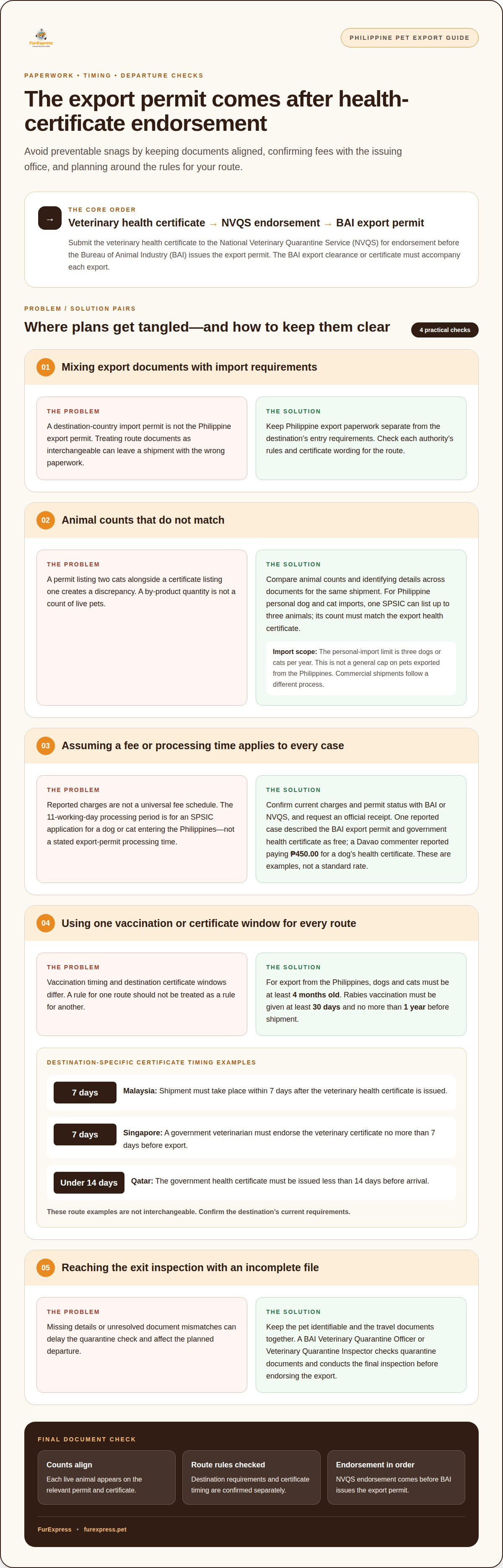
A pet’s export permit is the final paperwork step, not the first. Philippine pet export permit processing requires submitting a veterinary health certificate to the National Veterinary Quarantine Service for endorsement before the Bureau of Animal Industry (BAI) issues the export permit. The BAI export clearance or certificate must accompany each export.
It’s understandable to want clarity on paperwork, fees, and timing before arranging your pet’s trip. Small discrepancies, especially in the animal counts across documents, can complicate preparation, so work through each requirement in order.
This guide explains how to align the paperwork, what to know about permit and health certificate fees, and how processing time and validity can affect your travel schedule. It also covers preparing your pet and documents for the exit quarantine inspection, giving you a clearer plan for each step.
Key Takeaways
- Keep animal counts aligned across the applicable permit and health certificate, and separate Philippine export paperwork from destination-country import documents.
- Budget for permit and health-certificate steps separately; reported charges can vary by case and location.
- Plan around document issue dates and validity windows, which can depend on the destination and the type of certificate.
- Learn which role the BAI and quarantine service play, and how vaccination timing and exit inspection fit into export preparation.
Matching animal counts on permits and health certificates
- First, separate export paperwork from import paperwork. A pet leaving the Philippines needs its own export documents, while the destination country sets its entry requirements. If the route involves entering the Philippines, match the number of dogs or cats on the Sanitary and Phytosanitary Import Clearance (SPSIC) to the number on the export health certificate. For example, a permit listing two cats should not accompany a certificate listing one.
- Next, compare the animal counts across every document for the same shipment. For personal dog and cat imports to the Philippines, one SPSIC can list up to three animals, and its count must match the export health certificate. For commercial dog and cat shipments, match the SPSIC count to the APHIS export health certificate. Keep names and identifying details consistent so each record clearly refers to the same animals.
- For personal imports into the Philippines, the annual limit is three dogs or cats. The same microchipped animals may be imported more than once in a year, subject to a maximum of three animals. This is an import limit, not a general cap on pets exported from the Philippines. Commercial shipments follow a different process: the Philippine importer must be registered with BAI and approved for commercial imports.
- Finally, identify whether the shipment contains live pets or animal by-products. A dog or cat count belongs on pet permits and health certificates; do not treat a by-product quantity as a count of live animals. For animal by-product export information, identify the commodity separately in the shipment records and use the paperwork applicable to that product. Keep pet documents together and confirm that each live animal appears on the relevant certificate and permit before travel.
Export permit and government health certificate fees
Requirements differ by destination, so consult that country’s official animal-import authority for current rules. To avoid unofficial fees, confirm charges and permit status through BAI or the National Veterinary Quarantine Service, and request an official receipt.
-
Confirm the Issuing Agency and Requirements
First confirm that the Bureau of Animal Industry (BAI) issues the Philippine export clearance or certificate. The health certificate must be submitted to and endorsed by the National Veterinary Quarantine Service before BAI issues the export permit. Check the destination country’s requirements separately, because certificate wording and endorsements can differ. A destination import permit is not the Philippine export permit. Keep each authority’s requirements with the relevant part of your route.
-
Prepare Health Certificates and Export Clearances
Arrange the veterinary health certificate with your veterinarian, then submit it for endorsement before requesting the export permit. The documents serve separate purposes: the health certificate records animal health, while the BAI export clearance accompanies the shipment. For certificates connected with U.S. export certification, VEHCS refers to USDA-APHIS’s Veterinary Export Health Certification System. It is not the Philippine BAI permit portal. Follow the process for the authority issuing each certificate, and keep endorsed copies with your travel records.
-
Verify Permits and Official Fees
Compare the issued permit and certificate with your application, including the animal details and destination. The BAI export permit and government health certificate were free of charge in one reported case; a Davao commenter reported paying ₱450.00 for a dog’s health certificate. These reports are examples, not a universal fee schedule. Before paying, request the charge breakdown and official receipt from the issuing office. Avoid payments to personal accounts, and confirm permit status directly with BAI or the National Veterinary Quarantine Service.
Permit processing time and validity
Allow time for document review and any destination-specific certificate windows. Incomplete export documents or a delayed permit can affect departure: quarantine officers check the documents and inspect the pet before endorsing the export for Bureau of Customs processing.
- Separate Philippine export timing from Philippine import permit timelines. The 11-working-day processing period applies to an SPSIC application for a dog or cat entering the Philippines, from submission through evaluation, endorsement, and approval. It is not a stated processing time for a Philippine pet export permit. Keep the two routes distinct when planning dates.
- Plan the animal’s vaccinations around the export date. For export from the Philippines, a dog’s or cat’s rabies vaccination must be given at least 30 days before shipment and no more than 1 year before shipment. General Philippine export requirements also specify that pets must be at least 4 months old. Keep vaccination records with the travel documents.
- Check the destination’s certificate timing before arranging the veterinary visit. The windows differ by route: for Malaysia, shipment must take place within 7 days after the veterinary health certificate is issued. For Singapore, a government veterinarian must endorse the veterinary certificate no more than 7 days before export. For Qatar, the government health certificate must be issued less than 14 days before arrival. These examples are not interchangeable.
- Keep your pet identifiable and every document ready for the exit inspection. A BAI Veterinary Quarantine Officer or Veterinary Quarantine Inspector checks quarantine documents and conducts the final inspection before endorsing the export. Resolve any missing details before reaching the port. An incomplete file can delay the check and affect your planned departure.
- Use permit validity only for the route it covers. The 60-day validity period applies to a BAI SPS permit for importing a pet into the Philippines, not to an export permit. Match every certificate and permit date to the destination’s rules, then schedule travel within the applicable window.
Which Philippine agency issues permits to export pets, and what are the official requirements?
The Bureau of Animal Industry (BAI) issues the export clearance or certificate. Prepare the veterinary documents, vaccination records, and pet details for review.
- Start with the BAI-NVQSD application checklist. The Philippine animal-export certificate application is reviewed against that checklist, and its standard language is English. Organize the records in English and match each document to the pet and destination. This gives the reviewing office a clear file to assess before issuing the export certificate.
- Arrange a veterinary health certificate for your dog or cat. Submit it to the National Veterinary Quarantine Service for endorsement before the export permit is issued. The health certificate and BAI export clearance serve different purposes, so keep both with the travel paperwork. A veterinary certificate alone does not replace the BAI export clearance required to accompany an export.
- Plan the rabies vaccination around the shipment date. General Philippine export requirements state that a dog or cat must be at least 4 months old. Its rabies vaccination must be given no earlier than 91 days after birth, at least 30 days before shipment, and no more than 1 year before shipment. Destination-country rules may set additional conditions, so match the schedule to that route.
- Prepare your pet and documents for the port-of-exit check. A BAI Veterinary Quarantine Officer or Veterinary Quarantine Inspector checks the quarantine documents and conducts the final inspection. The officer endorses the export for Bureau of Customs processing. Keep the endorsed health certificate, export clearance, and supporting records together, and ensure the animal presented matches those documents.
For help organizing the export paperwork, use Philippine export permit processing assistance as a next step.
FurExpress: International Pet Cargo Transport
FurExpress can help coordinate international cargo travel and export paperwork when your pet is leaving the Philippines. International Pet Cargo Transport and Pet Excess Baggage Assistance support different travel arrangements, while Rabies Titer Testing Assistance can help with a destination’s testing requirements. For pets travelling into the Philippines, FurExpress also provides Pet Import Assistance to the Philippines. The services and scope are as stated in the written quotation.
Consider this support when you’re arranging documents and travel together, especially if your pet will fly as cargo or excess baggage. Veterinary care and decisions about your pet’s health remain with your veterinarian.
For help with your pet’s travel arrangements, contact FurExpress.
Plan the next stage of your pet’s journey
With the export paperwork underway, turn to the travel arrangements and the care your pet will need along the way. A step-by-step approach to Philippine pet export permit processing can make it easier to coordinate paperwork with the journey. Keep your veterinarian involved in decisions about your pet’s health and readiness to travel.
FurExpress offers Domestic In-Cabin Pet Travel, International In-Cabin Pet Travel, and International Pet Cargo Transport, subject to airline acceptance and route, as stated in the written quotation. These options suit different travel arrangements. Consider which fits your plans before coordinating the remaining details, keeping your pet’s needs central as you move from preparation to travel.
Contact FurExpress about pet export help and discuss support for your pet’s journey. Careful planning can help you move forward with greater clarity.
Frequently Asked Questions
How do I apply for a Philippine Bureau of Animal Industry veterinary health certificate for pet export?
Use the current BAI-NVQSD checklist to prepare an English-language application file. Label supporting records clearly with the pet’s identification and destination, so reviewers can connect each document to the correct export request. Keep the veterinarian’s records available if details need clarification. The veterinarian addresses the animal’s health; the Bureau of Animal Industry handles the government export documentation.
What documents are required to export a dog or cat from the Philippines?
The required file combines Philippine export paperwork with the destination’s entry documents. The destination sets its own import forms and health conditions, so there is no single document set for every route. Sort paperwork by issuing authority and purpose, then compare each document’s pet identification and destination details. This makes mismatches easier to spot before submitting the file for review.
How long does Philippine pet export permit processing take?
There is no single export turnaround that applies to every shipment. Timing depends on the application’s completeness and the destination’s requirements, including document endorsements or tests. For responsible planning, build a route-specific calendar working back from the destination’s arrival conditions. Allow time to correct discrepancies rather than relying on an assumed standard processing window.
What are the fees for pet export permits and veterinary certificates in the Philippines?
Confirm charges with the office issuing each government document, and keep official receipts with the export file. Veterinary services are separate from government permit processing, so ask for a clear cost breakdown before arranging appointments. Charges may depend on the service and issuing office. Do not assume another traveler’s payment is a standard fee for your application.
How far in advance should I apply for a Philippine pet export permit?
Begin planning as soon as you have a destination and likely travel date. The destination’s entry rules determine which documents need advance preparation, and certificate issue dates may need to fall within a specific window. Build your schedule around those conditions and your pet’s veterinary appointments. This helps avoid arranging a certificate too early to meet the destination’s requirements or leaving too little time to prepare supporting records.
What vaccinations, microchip, parasite treatments, and tests are required for pet export from the Philippines?
The destination country sets route-specific requirements for identification, vaccination, parasite treatment, and testing. Check its official animal-import rules for the exact combination and timing that applies to your pet, rather than relying on a general checklist for another country. Share those rules with your veterinarian, who can assess your pet’s health and vaccination records and advise on medical decisions.


